About Predictions and Markets

Two things happen when enough people react to a prediction:

1) the prediction comes true faster than it otherwise would under normal circumstances.

2) the prediction doesn’t happen at all.

Let’s take a look at two cases that cover each of the aforementioned scenarios:

Scenario 1: If enough people believe in the bright future of a company, they start bidding up its share price even if it is still losing money every quarter. The higher stock price will allow that company to hire the brightest employees and management; to buy promising smaller competitors, which will lead to a better market position. The overall improvement in profitability will be accepted as a positive feedback by the market and even more people will buy this company shares. Everything will happen a lot faster than it otherwise would. In this case, the initial expectations of a brighter future could turn into a self-fulfilling prophecy. When good market faith meets smart management, a story stock could appreciate very quickly.

Scenario 2: If enough market participants believe that there’s a major correction coming around the corner, many would simply buy put options to protect long-term positions and ride out the storm with a minimum drawdown. One could argue that if enough people believe there’s a deep correction coming, everyone will sell and actually cause this correction to happen faster and be even bigger. The truth is that funds that actually move markets don’t go to 100% cash. They just reallocate capital between less liquid, but more lucrative asset classes and hedge. Since everyone will start buying protection, volatility will spike. Equity prices might not drop more than a few percent because most funds would be already protected and they won’t sell their positions. Put options will expire worthless. Correction predictors will be made fun of. Everything will go back to normal. By definition, deep market correction always comes by surprise for most. If enough people expect a correction and act on their perceptions, it will either not happen at all or it will be much shallower than most expect. I’d be a lot more concerned when the market is down 5% and everyone is blindly buying the dip than when the market is down 5% and implied volatility is through the roof because everyone is afraid and buying protection.
The Twitter Dilemma

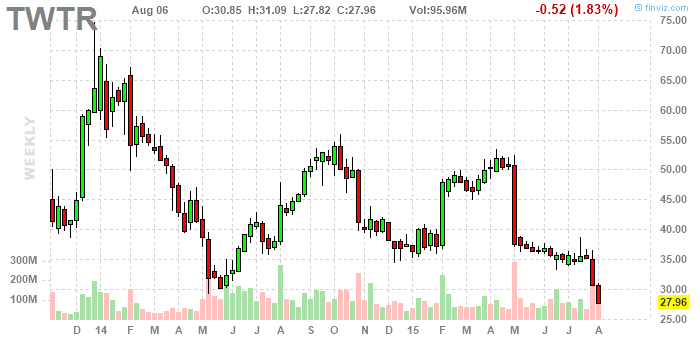
Many people are emotionally invested in Twitter and don’t comprehend the reason behind its poor track record as a publicly traded stock.

chart-2


Twitter is still a great product. Many of us still love it and use it every day. The problem with Twitter is that they stopped growing fast enough and when you stop growing, the market starts to pay attention to valuation. Its valuation is still steep.

When a young tech company is still growing quickly, the stock market doesn’t pay attention to valuation because it assumes that profits will come later. It is the Amazon’s model. Reinvest everything you make in projects that will fuel future growth and presumably a lot bigger profits down the road. Essentially, investors are often taking a leap of faith in:

1) their own ability to manage risk properly and

2) the ability of management to deliver.

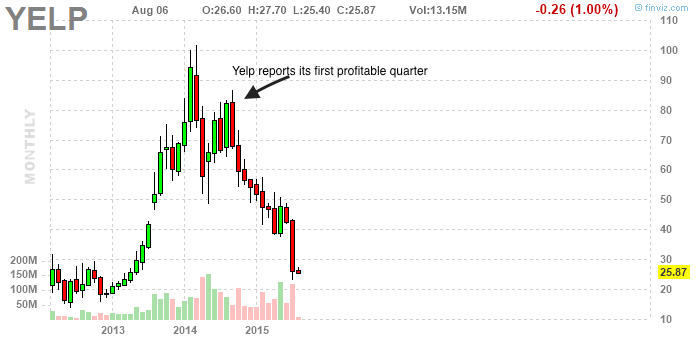
Financial markets are forward-looking by default. They often discount events that haven’t happened yet. As a result, they will sometimes price in events that will never happen. Take the story of Yelp for example. YELP quadrupled long before it reported its first profitable quarter. Take a look what happened after this long-awaited event. The market gradualy realized that its expectations for Yelp are way too high and that its management won’t be able to deliver.

chart-1

Yelp is hardly the only example of a public company rising quickly in market cap while still losing money every quarter.   Companies could be losing money because they invest heavily for future growth or they could be losing money because of a flawed business model. You want to stick with the former. The problem is that in many cases, the reason is clear only in hindsight, which means that we have only one option when dealing with momentum stocks – trust price. If price action gets us in, price action should gets us out.

It is normal for a story stock to double and triple in a year as investors’ expectations grow much faster than the ability of a company to deliver. In fact, this is the story of most momentum stocks and the reason why many of them give back 50% to 80% of their upside move.

The lesson? Always have an exit strategy, because sooner or later every trend ends.


Quick Look At Market Breadth

In the examples below, I am using S&P500 data as a proxy for the market.

First a short-term perspective: About 37 % of the SPX stocks are still trading above their 20-day moving averages. This doesn’t provide an edge for either bulls or bears. Extreme readings have led to mean-reversion in the indexes during the predominantly range-bound market environment of 2015. Oversold readings (reaching a value under 20%) hasn’t always led to an immediate bounce in the averages. For a more sustainable bounce, look for a divergence – bigger percentage of SPX stocks trading above their 20dma while the SPX keeps making new lows.

1

Things are looking a lot different from a long-term perspective:

The % of SPX stocks trading above their 200dmas is almost back to its levels from October 2014, when  we had an almost 10% market pullback.

2

The % of stocks, making new 52-week lows is at multi-year highs. The deterioration in any industry even remotely related to commodities has been breath-stopping.

3

The number of stocks making new 52-week highs has been gradually declining in 2015 and it has now established in a low-value tight range. SPX has managed to keep near multi-year highs thanks to healthcare, financials, tech and consumer discretionary stocks.

4