10 Things I Learned from Steve Jobs about Trading and Life

Less is more, simple is good.

That’s been one of my mantras—focus and simplicity. Simple can be harder than complex; you have to work hard to get your thinking clean to make it simple.

Your first loss is your best loss

Sometimes when you innovate, you make mistakes. It is best to admit them quickly, and get on with improving your other innovations.

When studying the market and speculating about the future, the past is all we have.

You can’t connect the dots looking forward; you can only connect them looking backward. So you have to trust that the dots will somehow connect in your future. You have to trust in something — your gut, destiny, life, karma, whatever. This approach has never let me down, and it has made all the difference in my life.”

No one gets paid for originality – you get paid for making money. You should be happy to take other people’s good ideas and run with them, as long as you understand exactly why you are in the trade and take full responsibility of the results. If you don’t know why you are in a trade, you won’t know when to exit.

Ultimately, it comes down to taste. It comes down to trying to expose yourself to the best things that humans have done and then try to bring those things into what you’re doing. Picasso had a saying: good artists copy, great artists steal. And we have always been shameless about stealing great ideas, and I think part of what made the Macintosh great was that the people working on it were musicians and poets and artists and zoologists and historians who also happened to be the best computer scientists in the world.

The market is constantly changing. We should anticipate, not blindly react to what just happened.

You can’t just ask customers what they want and then try to give that to them. By the time you get it built, they’ll want something new.

There is an opportunity cost in everything we do. If you are going to spend any time trading and reading about the market, you better learn how to trump the market, not to merely achieve an average return. Otherwise, a low-cost index can do that for you.

My favorite things in life don’t cost any money. It’s really clear that the most precious resource we all have is time.

Focus, focus, focus. Every week or every day have a small watchlist of actionable ideas to work with. I like to prune my lists and keep in them primarily stocks with high industry momentum.

I’m as proud of many of the things we haven’t done as the things we have done. Innovation is saying no to a thousand things.

One great risk/reward setup in a currently hot industry is better than 10 mediocre setups from random industries

Quality is more important than quantity. One home run is much better than two doubles.

Love what you do. Otherwise, don’t even bother. Make trading fit your life, not your life fit your trading.

For the past 33 years, I have looked in the mirror every morning and asked myself: ‘If today were the last day of my life, would I want to do what I am about to do today?’ And whenever the answer has been ‘No’ for too many days in a row, I know I need to change something.

Don’t give up. There’s always a way.

I’m convinced that about half of what separates successful entrepreneurs from the non-successful ones is pure perseverance.

Don’t be afraid to experiment and try new things until you find the right approach for you. Your relationship with trading should be stimulating and pleasurable.

Getting fired from Apple was the best thing that could have ever happened to me. The heaviness of being successful was replaced by the lightness of being a beginner again. It freed me to enter one of the most creative periods of my life.

The best time to start to learn is always today. It’ll never be perfect. Just start and do something you enjoy and want to become really good at.

Remembering that you are going to die is the best way I know to avoid the trap of thinking you have something to lose. You are already naked. There is no reason not to follow your heart.
The Only Time to Safely Bottom Fish for a Stock Is …

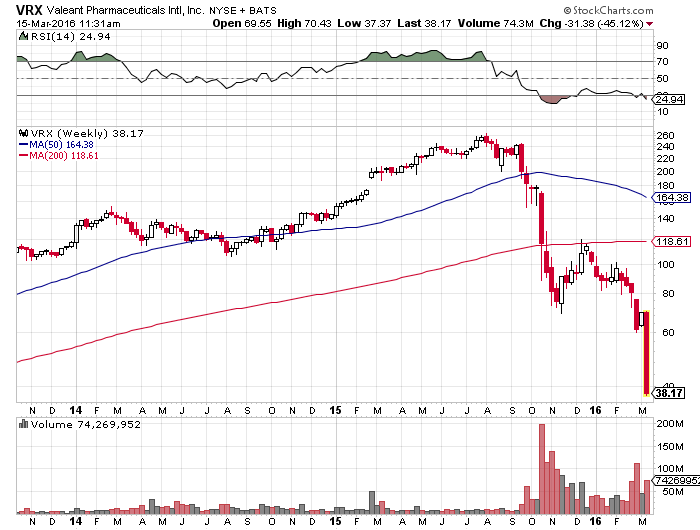
VRX is down another 40% this morning, extending its drawdown to 85% from its 52-week high reached last summer. I am not familiar with VRX’s fundamentals and I am not going to argue about them. My point is strictly about technicals and sentiment.

Over the past few weeks, many have been pointing out to a positive momentum divergence in VRX – its price made new price lows in early March while its RSI didn’t. For some this is enough to put it on their watch list and wait for some signs of strength before entering on the long side. While it is true that momentum often leads price, price is the only thing that actually pays us. The delay between a positive momentum divergence in individual stocks and price reversal could be substantial or longer than most people could remain solvent and sane. Plus, this signal doesn’t always work. No indicator does.

sc-1

My friend Frank Zorrilla made a really interesting observation this morning:

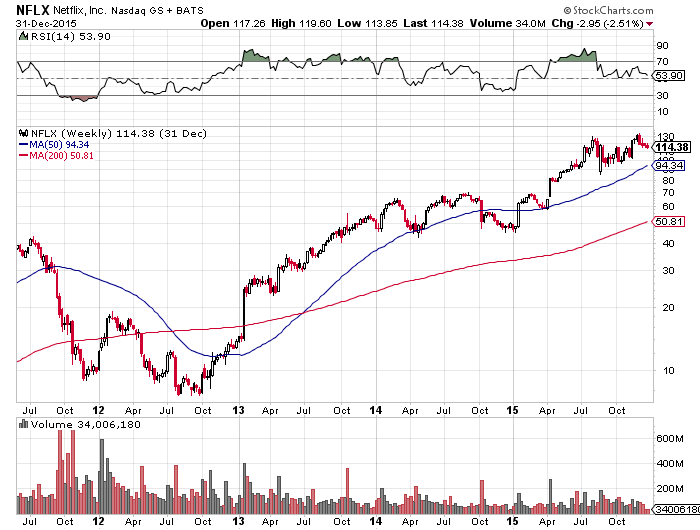
$VRX is the reason why you don’t bottom fish, $NFLX back in 2012 is why you do…that settles it…

— Frank Zorrilla (@ZorTrades) Mar. 15 at 07:35 AM

NFLX also lost 80% of its market cap in 2011/2012. The difference is that then it spent multiple weeks in a tight, low-volume range, which is the ultimate sign of neglect. Then, it made a new 52-week high in early 2013 and it never looked back. It went up more than 400% in the next 3 years. You didn’t have to bottom fish for NFLX. You could have been “late” and wait for a fresh breakout from a consolidation and still achieved a substantial return. The best performing stocks in any given year are usually the ones that surprise the most. This means that they will often come from a place very few expect – they are likely to be widely neglected before and even after their major high-volume breakout to new 52-week highs.

sc-2

There is a time and place for each market strategy.

Stocks that make new 52-week lows in a bull market are usually there for a good reason. From my perspective, there’s only one market environment where it is relatively safe to try bottom fishing and the potential reward far outweighs the risk taken. It is during market corrections when the general market tests its momentum lows with some form of breadth divergence. In my book CRASH, I describe the five stages that a typical market correction goes through:

  1. The Guillotine Stage – fast sharp decline that last 1-3 weeks and leads to a 5-10% loss in major indexes and leads to extremely oversold market breadth readings. Volatility spikes through the roof during this stage and it stays there. Indexes close below their 200-day moving average.
  2. Short-term bounce that gains back 30-50% of the sharp decline in stage one. Such bounces often find resistance and reverse lower at declining 10, 20, 50 or 200-day moving averages.
  3. Choppy market environment, that gradually whipsaws both bulls and bears as market often changes directions and daily price ranges are extremely wide. During this stage, fear is gradually replaced by apathy and lack of interest in the market.
  4. A retest of the momentum low achieved in stage 1. There is usually some type of breadth divergence – indexes are piercing below their momentum lows but with improved internals – there’s a smaller percentage of stocks making new 20-day lows than in stage 1. If indexes cannot sustain bounce after this retest, we are probably in the midst of a bear market or a lot longer correction, at least.
  5. Recovery – correlations are very high at this stage. Indexes quickly reach overbought levels and stay there for a long time. Those who wait for a pullback, miss the boat.

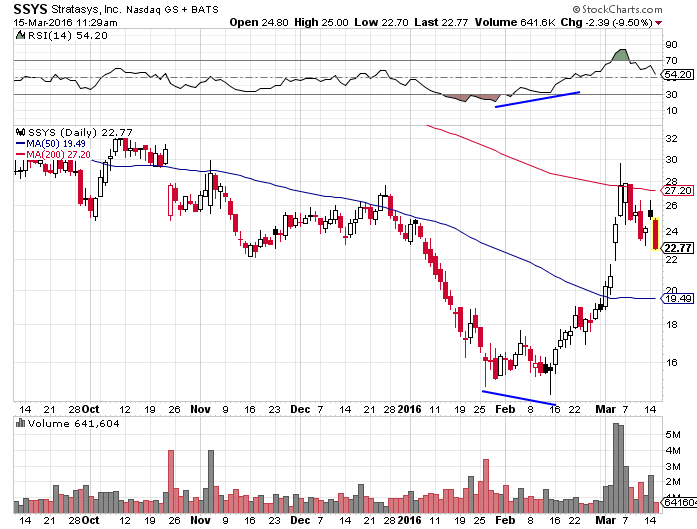
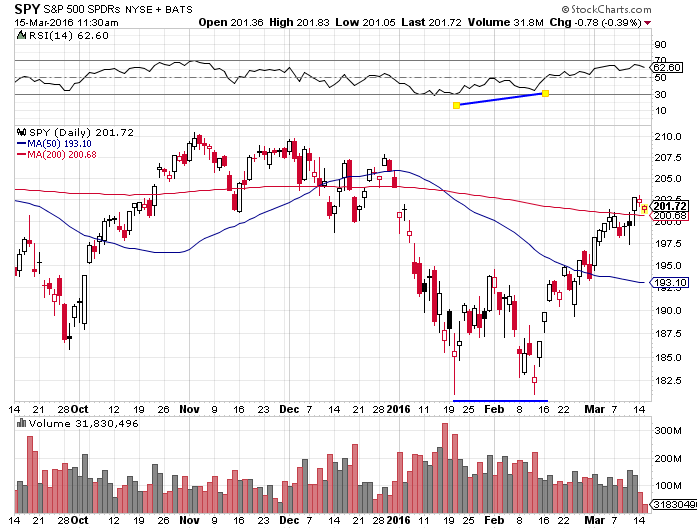
Most stocks tend to top individually, but they bottom together as a group. Fishing for beaten down stocks that are down 80% or even 90% from their 52-week highs only makes sense in stage four of a typical market correction. Here’s a recent example.

1

2

What Overbought Breadth Readings Mean?

Various market breadth readings have been overbought for a week already. In most situations, it means that a short-term pullback is likely. There is one exception. When stocks recover from a deep correction, it is normal for market breadth to quickly reach overbought levels and stay there for quite some time while sector rotations take care of the extremes.

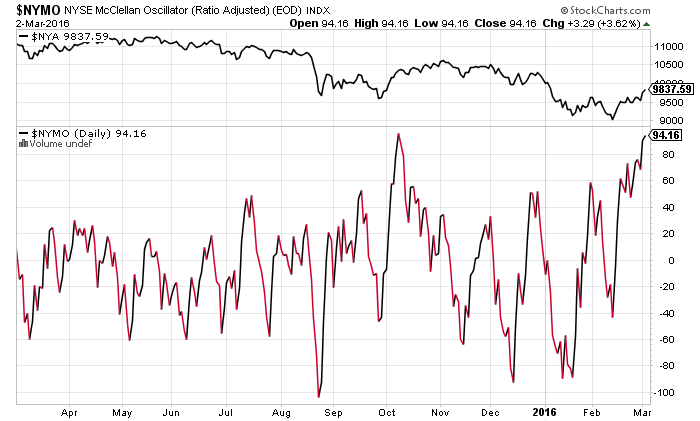
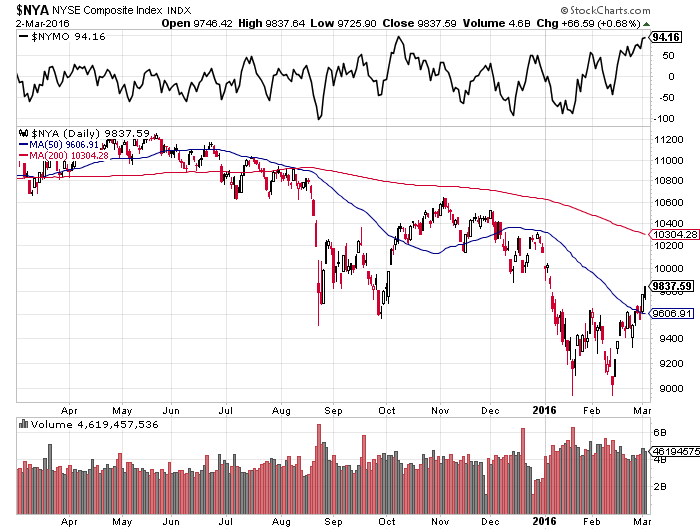
Look at the chart below featuring the New York Stock Exchange Composite (NYA) and the NYSE McClellan Oscillator ($NYMO).

sc

There are two lessons from this chart:

1) In October 2015 and in February 2016, the index made a new price low with a positive breadth divergence. NYA made new lows while NYMO didn’t. This marked a short-term bottom and the beginning of a powerful rally. Study any past correction and you will realize that bottoms are formed when there’s some form of positive breadth divergence and market breadth always bottoms before price.

2) In October 2015, NYA continued to advance even after breadth readings (NYMO) reached extremely overbought territory and started to pull back. Sector rotations and skeptics coming back on the long side kept the rally going until NYA reached its declining 200dma. It is still below its declining 200dma, but this is another discussion to have. Study any past correction and you will realize that market breadth (NYMO) always reaches super-overbought readings when indexes are recovering from a >10% decline. Those overbought readings don’t usually lead to an immediate decline in the indexes. On the contrary, in most cases the indexes continued to slowly climb higher. Those who were afraid to jump back in because of overbought breadth readings were in a way locked out of the rally. The market didn’t give them a chance to get back in. It is the nature of the market to surprise the majority.

I am not saying that overbought and oversold market breadth readings should be ignored. On the contrary, they are very useful indicators most of the time. Everything should be looked in context. There are always exceptions to the rule. Knowing when an indicator can be ignored is just as important as knowing when it could be trusted.

Here is a different perspective of the same relation.
sc-1