5 Market Insights from Marty Schwartz

Marty Schwartz is an independent trader, who was a legend in the 1980s. He was featured in the first Market Wizards book. Here’s Jack Schwager’s description of Schwartz:

In nine of the ten four-month trading championships he entered (typically with a starting stake of $400,000), he made more money than all the other contestants combined. His average return in these nine contests was 210 percent—nonannualized! (In the one remaining four-month contest he witnessed a near breakeven result.) In his single entry in a one-year contest, he scored a 781 percent return.

5 notable quotes from Schwager’s interview with Schwartz:

  1. I always take my losses quickly. That is probably the key to my success. You can always put the trade back on, but if you go flat, you see things differently. The pressure you feel when you are in a position that is not working puts you in a catatonic state.

  2. Learn to take losses. The most important thing in making money is not letting your losses get out of hand. Also, don’t increase your position size until you have doubled or tripled your capital. Most people make the mistake of increasing their bets as soon as they start making money. That is a quick way to get wiped out.

  3. Most people would rather lose money than admit they’re wrong. What is the ultimate rationalization of a trader in a losing position? “I’ll get out when I’m even.” Why is getting out even so important? Because it protects the ego. I became a winning trader when I was able to say, “To hell with my ego, making money is more important.”

  4. I always check my charts and the moving averages prior to taking a position. Is the price above or below the moving average? That works better than any tool I have. I try not to go against the moving averages; it is self-destructive. (in his book Pit Bull, Schwartz says that he is using a 10-period exponential moving average).

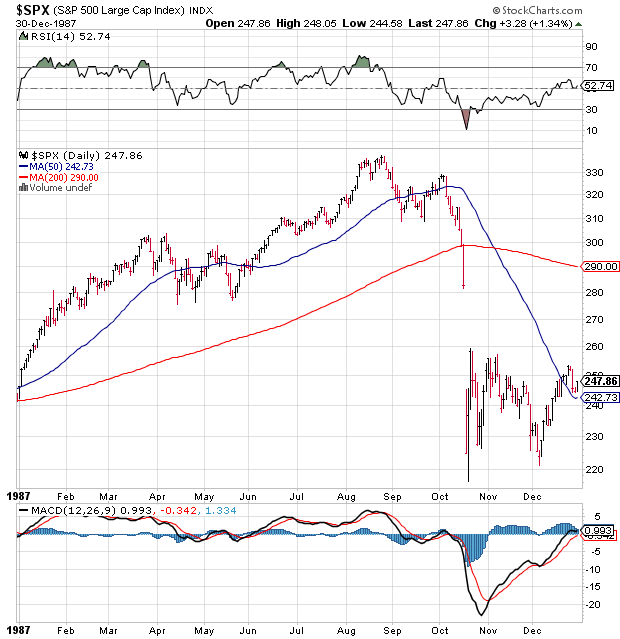
  5. What was your experience during the week of the October 19, 1987 stock crash?

    I came in long. I have thought about it, and I would do the same thing again. Why? Because on October 16, the market fell 108 points, which, at the time, was the biggest one-day point decline in the history of the stock exchange. It looked climatic to me, and I thought that was a buying opportunity. The only problem was that it was a Friday. Usually a down Friday is followed by a down Monday.

    The high in the S&P on Monday was 269. I liquidated my long position at 267.5. I was real proud of that because it is very hard to pull the trigger on a loser. I just dumped everything. I think I was long 40 contracts coming into that day, and I lost $315,000.

    One of the most suicidal things you can do in trading is to keep adding to a losing position. Had I done that, I could have lost $5 million that day. It was painful, and I was bleeding, but I honored my risk points and bit the bullet.

    I thought about going short, but I said to myself, “Now is not the time to worry about making money; it is the time to worry about keeping what you have made.” Whenever there is a really tough period, I try to play defense, defense, defense. I believe in protecting what you have.
    spy1987-daily

    Source: Schwager, Jack D. (2012-01-09). Market Wizards: Interviews with Top Traders. Wiley. Kindle Edition.

    Related reading: Size Matters
13 More Thoughts about Bear Markets

FullSizeRender (1)

A couple weeks ago I shared some of my musings about market corrections. Here are a few more of them:


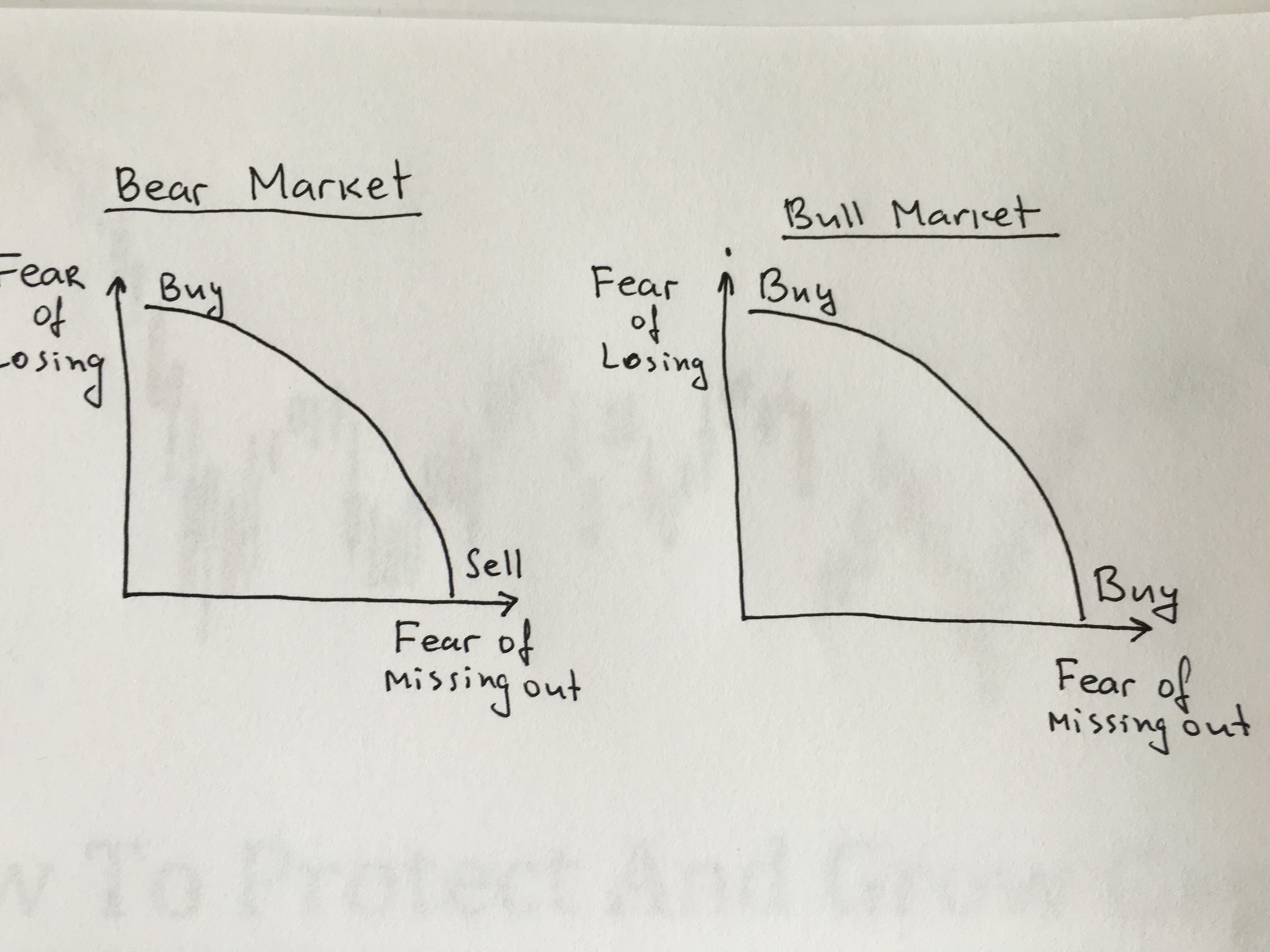
1.Bull markets reward risk-taking, but when the bear puts out honey, he is usually laying a trap.

2. In bear markets, indexes can remain oversold longer than most dip buyers could remain solvent. In bull markets, oversold market breadth readings lead to bounces. In bear markets, short setups often continue to work even during oversold conditions, especially during the initial stage lower.

3. Never say never. Absolutely anything can happen. Even stocks of the strongest companies can and will decline substantially during market corrections. When a market correction starts, some of your stocks will gap below your stops. Justifying holding individual positions below their stop levels, because the general market is oversold or might soon become oversold is not wise. Losses could escalate very quickly in a bear market. Act as a professional and take your next best loss. Not selling your losers means that you believe that they will outperform the rest of the available setups. Whether you are a trader or an investor, if you deal with individual stocks, you always need to have an exit strategy. If you can’t take a small loss, sooner or later you will have to take a very large loss.  Consider potential future winners you might miss because of the effect of a larger loss on mental attitude & trading size.

4. You could be right on a market and still end up losing if you use excessive leverage. Bear markets are very volatile. A small move against your overleveraged position could take you out. This is why averaging down in the midst of a correction is not for most people. It takes a strong stomach and a very deep pocket.

5. In bull markets, oversold technical readings lead to a bounce. In bear markets, you need a major news change like FED or ECB announcement for a rally. Some of the most powerful rallies happen below declining 200-day moving averages.

6. When you are in a losing streak, you can’t turn the situation around by trying harder. Go to cash in order to gain some objectivity. Take a break from the markets.

7. Buying stocks of companies, which products & services you love and use works great in a bull market. Not so much in a bear market.

8. Price action might impact fundamentals just as much as changes in fundamentals can impact price action. Sustained lower stock prices eventually lead to worse fundamentals in many cases. Low P/Es today often foreshadow lower earnings in the future.

9. Recency bias and placebo effect rule much of market’s action. Price action often defines the tone of news. Scary headlines tend to appear after markets break down. Positive headlines appear after markets bounce. With other words, the market is better at predicting the news than the news is at predicting the market.

10. Appreciate all trending markets – up or down. A downtrend is better than a choppy market. In fact, stocks tend to move a lot faster during corrections. Corrections are rare and a good trader knows how to take advantage of them. In fact, a good trader appreciates and loves corrections, because they provide incredible opportunities – first on the short and then on the long side. A correction is among the best things that could happen to a prepared trader with a plan of action.

11. When most people feel like buying the dip is a good idea, it is usually not. When most panic and start wanting out at any price, it is time to enter for trade. It is easier said than done. It is not something that can be quantified or explained. It is something that has to be experienced, multiple times. One hint regarding bottoms: they are made by heavy buying, not heavy selling (even though the latter is often a prerequisite).

12. 80% of bear markets or steep corrections is choppy price action, which might whipsaw both bulls and bears. Long bear markets make smart traders appreciate bull market a lot more, not take them for granted and take a lot better advantage when they come back. They always do.

13. Bear markets turn investors into day traders and traders into buy & hold investors. By the time a bear market is over, most active market participants are conditioned to take small gains. This might turn into a drawback in the initial stages of a recovery, when markets become less choppy and trend better.

Don’t worry about what the markets are going to do, worry about what you are going to do in response to the markets. In the end, we should focus on only what we can control: our market exposure, equity selection, entry, exit and position size.

Check out my book, CRASH – How to Protect and Grow Capital during Market Corrections.

Some Corrections Turn into Bear Markets

“A bull market is when you check your stocks every day to see how much money you’ve made. A bear market is when you don’t bother to look anymore.” – Bruce Kamich

In her excellent book “Bull”, journalist Maggie Mahar interviews Richard Russell on the three psychological stages of a bear market:

“The earliest stage is characterized by denial, increased anxiety, and fear. The second stage is panic. People suddenly say, ‘I’ve got to sell.’ The third phase is despair.” In the third phase, investors are so tired of the stock market that they don’t want to hear about stocks anymore, at any price”

Most corrections will remain just that – corrections. They won’t turn into bear markets. They will last a few weeks or few months. In the end, indexes will recover to new highs.

And yet, some corrections turn into bear markets. They are rare, but over 30-40 years of investing or trading, you will probably experience at least two or three of them – if market patterns continue to repeat. As long as there are humans involved, you can count on it. Markets always overshoot to the upside and the downside, because people’s psychology is cyclical and people tend to underreact to new information, then panic and overreact. Overreactions create the foundations for mean-reversions. Booms eventually lead to busts and busts to booms.

My definition of a bear market – spending a long time (more than a year) under a declining 200-day moving average, leading to 50% or bigger decline in a major, wide-encompassing index, like the S & P 500 for example.

You can imagine if an index is down 50%, what can happen to many individual stocks. No stock is insured against a bear market. Apple and Google lost 60% during the bear market in 2008. Amazon lost 95% during the bear market of 2000-2002. Priceline lost 99% in the same period. All of them managed to recover and hit new all-time highs afterward, but do you really think that you could have stomached the drawdowns that you had to go through? Do you really think that you could have put $1 million into PCLN and watch it turn into 10,000 and ride it all the way back without spooking at some stage and selling everything? Think again.

Are you familiar with the 50/30/20 concept? It states that 50% of a stock’s move is defined by the general market direction; 30% – by its industry; and only 20% is impacted by the individual merits of the underlying company. In a bear market, the 50/30/20 rule of thumb become something like the 90/10 rule, where 90% of a stock’s move is defined by the general direction of the market and only 10% – by the individual characteristics of that stock.

Traders should trade. Investors should invest. Whether you are a trader or an investor, if you deal with individual stocks, you always have to have an exit strategy. Some stocks never come back from their big drawdowns during market corrections.

This is a small excerpt from my book CRASH: How to Protect and Grow Capital during Corrections