Markets Will Be Markets

The stock market is bipolar creature, driven by sentiment and irrational expectations. One day, it is an ingenious forward-looking mechanism that anticipates and discounts future events beautifully. Another day, it is a stubborn schizophrenic that can’t see further than its nose.

Markets constantly overreact to both, identified risks and opportunities. It is in the nature of financial markets to exaggerate, to magnify. This is why they are not always discounting the future. Sometimes, they are correcting previously incorrect view. Sometimes, they just go bonkers and send prices to levels that cannot possibly be justified by any future scenario. Boys will be boys. Markets will be markets. They’ll fluctuate violently, up and down and to levels that will seem incomprehensible to many. Indexing, robo-advising and social media won’t change that. The Internet might have made people smarter; but it hasn’t made financial markets more efficient. You could complain and whine about financial markets’ irrationality or you could find a way to take advantage of it. Or don’t. It’s your choice.

If you understand people’s incentives, you are very likely to predict correctly their future behavior and sometimes even influence it. Most incentives have expiration date. What is important today, might not be as important tomorrow. This applies perfectly to life, but not always in financial markets that live in their own world. Incentives require the existence of rationality. We have already made the point that more often than not, markets are not rational, but emotional, at least in a short-term perspective. As Howard Marks eloquently puts it:

Psychological and technical factors can swamp fundamentals. In the long run, value creation and destruction are driven by fundamentals such as economic trends, companies’ earnings, demand for products and the skillfulness of managements. But in the short run, markets are highly responsive to investor psychology and the technical factors that influence the supply and demand for assets. In fact, I think confidence matters more than anything else in the short run. Anything can happen in this regard, with results that are both unpredictable and irrational.

Check out my latest book: “The 5 Secrets to Highly Profitable Swing Trading”
Algos Have Made Financial Markets More Inefficient

Caribbean_general_map

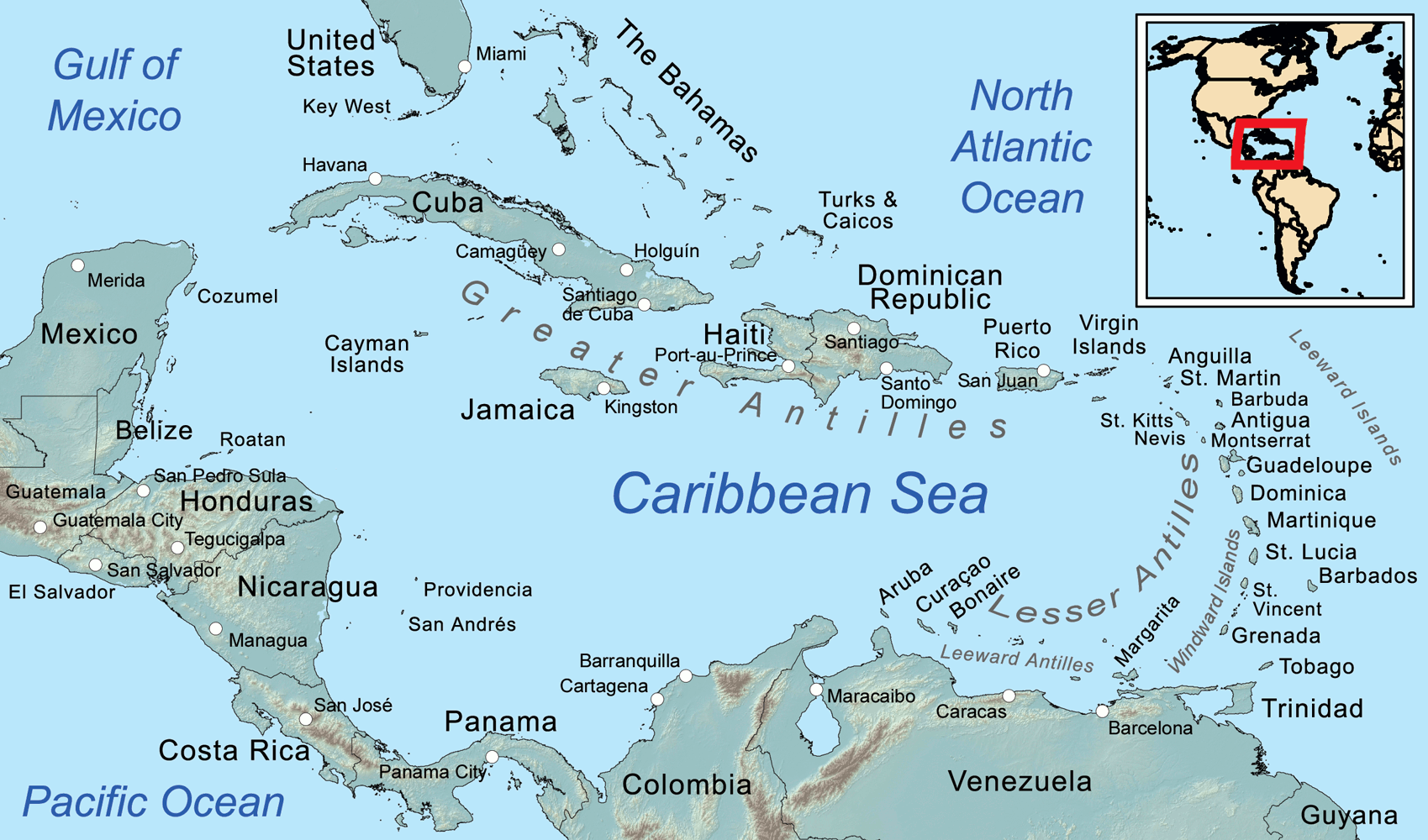
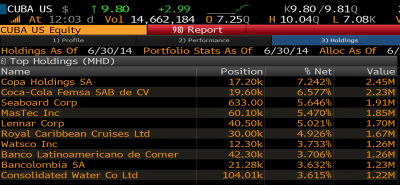
A couple weeks ago, President Obama announced that he is ready to relax restrictions for Cuba. The result – a little-known closed end fund trading under the symbol $CUBA skyrocketed. On December 17, it traded 48 times its average daily volume. In the midst of the very same trading day, some of the most read financial bloggers pointed out that CUBA’s current holdings might have very little to do with Cuba.

CUBA-holdings

This fact didn’t stop $CUBA from doubling in five trading days. At some point it was trading at 70% premium above its net asset value, which basically means that everyone could’ve bought $CUBA individual holdings for a lot less. This phenomena didn’t last long. Warren Buffett once said “Time is the friend of the wonderful business, the enemy of the mediocre.” The same thing applies to stocks and ETFs, sometimes.

chart

The big questions here are, why did the market over-react so much and why did it take so much time to correct the excess? In the era of social media, when everyone is supposed to have access to more information (noise) and higher quality analysis, we continue to see the same over-reactions and under-reactions as 10-20 years ago.

In the case of Cuba, people knew that those changes mean repricing. When people and algos have no idea how to play a change, they go with the next best thing – price and volume. Here’s what was probably going on in the mind of a shrewd speculator: “$CUBA is going up on huge volume, so somebody must know something. Even if the market turns out to be wrong, I will be out with a hefty profit long before that. It’s all about risk and reward.”

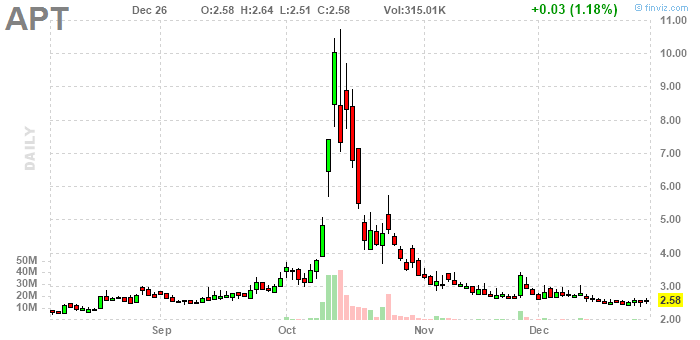
Intra-day traders and algorithms act on price, volume, key words and momentum and they have plenty of purchasing power to create powerful moves. Those moves are often exacerbated by early short-sellers, who don’t know when to step away from the freight train. Do you remember the huge rallies in ebola related stocks in October, when we saw 100% to 500% moves in less than two weeks?

chart-3

Sometimes, ignorance is a bliss. The people who made the most money in the late 90s were those who knew nothing (not sure if they kept it) and those who knew a lot, but also knew when their knowledge was a hurdle.

Market is forward-looking, but sometimes it goes a little bonkers. You could complain about its irrationality or accept it as an inherent part of what it is and create a system that could take an advantage of it.

Check out my latest book: “The 5 Secrets to Highly Profitable Swing Trading”
My 2015 Predictions

2238715683_ff8a6a16f6_z

Predictions are very one-dimensional. You are either right or wrong and as we know from George Soros this is not the most important thing in investing. It is far more important how much money we make, when we are right and how much we lose when we end up being wrong.

There are two main approaches to forecasting – you either assume that current trends will continue or they will violently reverse. I have no idea what 2015 will bring and I don’t have to in order to have another great year. I believe in conditional thinking – if this happens, then this is what I am going to do. When the proper setups show up, I take them. With that in mind, here are my educated guesses on what 2015 could bring.

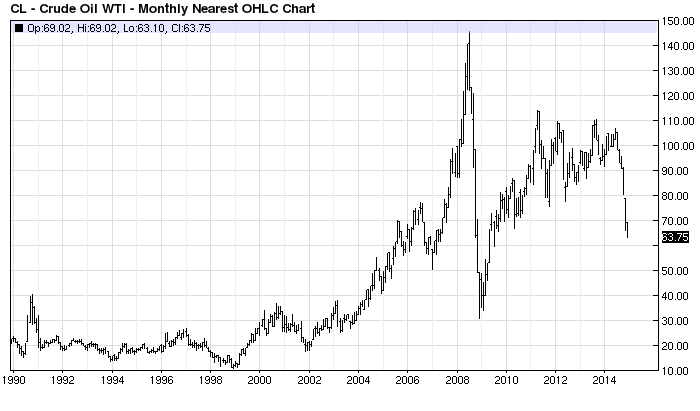
1. Crude Oil will stabilize, but stay under $70 during the entire 2015. This will create positive environment for consumer discretionary stocks.

oil

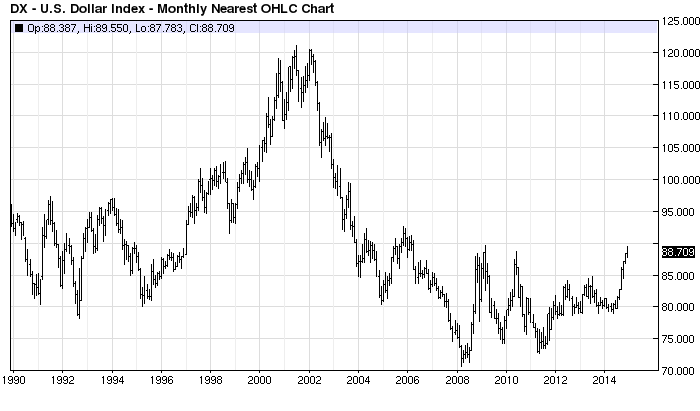
2. The U.S. Dollar will get even stronger against all other major currencies. Everyone else will have to QE to boost economic growth. Japan has already launched the biggest QE program in the world history (for the size of its economy). China is cutting interest rates and ready to devalue the Yuan. The ECB will likely start buying government bonds. Yes, the U.S. Dollar has had big jump in 2014 and it could use some form of consolidation, but over the next few years, it is the best house in a bad neighborhood. It’ll rise against all other currencies.

usd

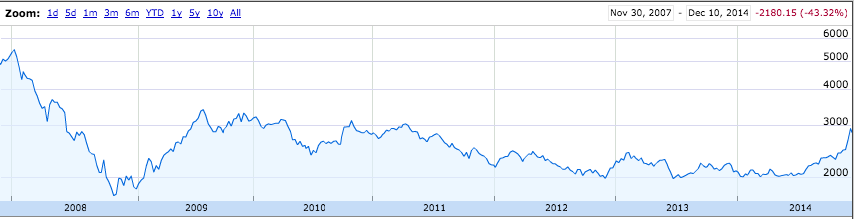
3. Cheap oil is a huge tailwind for China, India and Europe. China was supposed to crash in the past few years. Guess what? It did. The Shanghai Composite is essentially flat for the past 5 years, while the Chinese economy grew at 7-8% annually. The Chinese GDP has almost doubled for the past 5 years, while their stock market has been a dud. Things started to stir up in late 2014 and we will probably see The Shanghai Composite catching up and continuing to outperform in 2015.

china

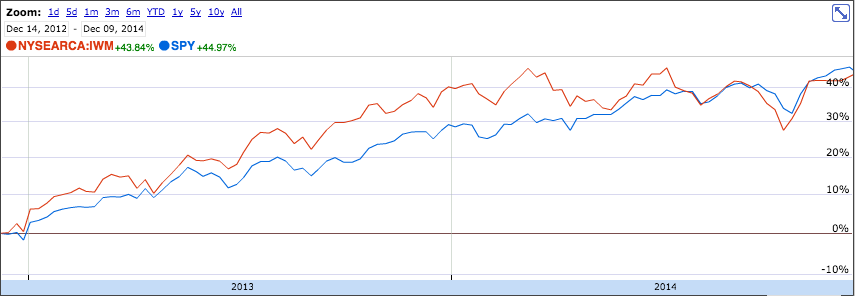
4. Small caps will outperform, at least in the first half of the year. Large caps will probably be flat for the year. Small caps have spent the last 10 months building a potential launching pad after their big year in 2013. If IWM clears 121, the chase will be ON and momentum leaders will crush the market averages.

iwm

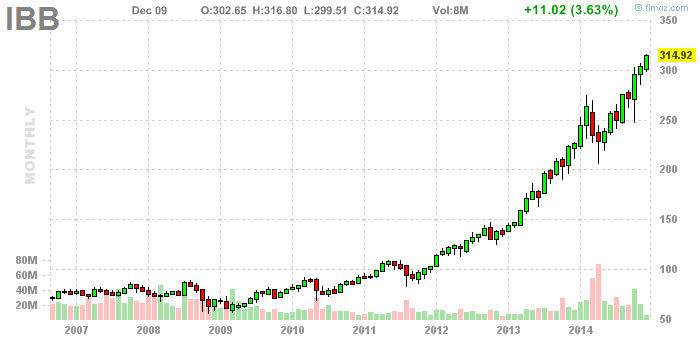
5. Biotechs will continue to be in the spotlight.IBB has been overdue for a big pullback for quite some time, but it could easily go a lot higher. The biotech ETF IBB is up more than 200% for the past 3 years. The last time a major sector tripled in such period of time was in the mid to late 90s with technology. Do you know what happened after that? The Nasdaq Composite doubled again before it crashed. Maybe, we will see something similar in biotechs. We will probably see a substantial pullback right before tax deadline in April as people sell their big biotech winners to pay Uncle Sam.

ibb

6. The market averages will see at least two deeper than 10% corrections during the year. This is usually a safe bet, as it has happened almost every year. As always, the absolute best time to put on long-term positions is after the market averages are down >10% and select stocks start to break out to new 52-week highs from proper bases.

Check out my latest book: “The 5 Secrets to Highly Profitable Swing Trading”
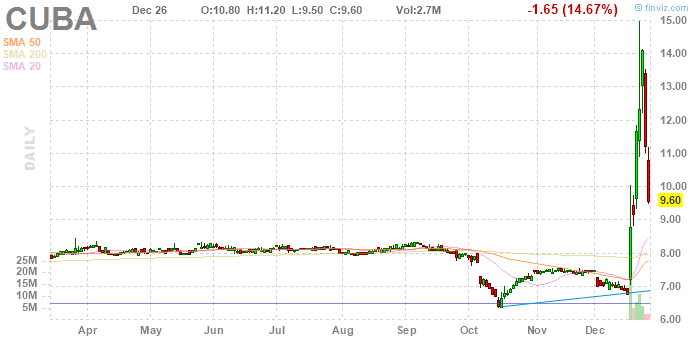
Photo Credit: circulating