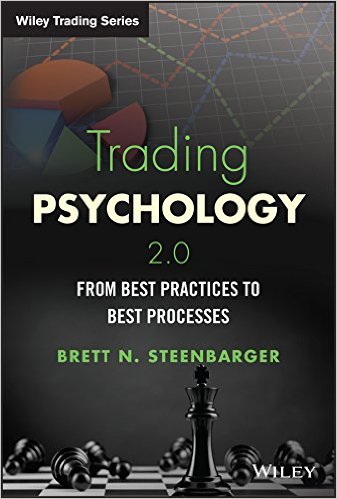
I made so many highlights on Trading Psychology 2.0 that my kindle copy looks like a Christmas tree. I find it deeply insightful, eye-opening and a great source of fresh ideas on how to bridge the gap between where we are today and where we would like to be – not only in trading but in life.
Trading Psychology 2.0 is based on four major themes: Adapting to changing markets; Building strengths; Cultivating creativity; and Developing best practices and processes. Here are fifteen interesting quotes from the book:
1. Discipline, while necessary for success, is never sufficient. Discipline does not substitute for skill, talent, and insight. Strict, disciplined adherence to mediocre plans can only lock in mediocre results. If it were otherwise, there would be no losing automated trading systems.
2. It is not enough to find an “edge” in financial markets; as any tech entrepreneur can attest, competitive advantages are perishable commodities. Those who sustain success continually renew themselves, uncovering fresh sources of competitive advantage. That requires processes for assessing and challenging our most basic assumptions and practices. It takes a good trader to create success, a great one to recreate it. Nothing is quite as difficult— and rewarding— as letting go of what once worked, returning to the humble status of student, and arising phoenix-like from performance ashes.
3. This productivity is readily apparent on a day-to-day, week-to-week basis: The greats simply get more done than their colleagues. They organize their time and prioritize their activities so that they are both efficient (get a lot done per unit of time) and effective (get the right things done). How much time do we typically waste as traders, staring unthinkingly at screens, chatting with people who offer little insight, and reading low-priority/ information-poor emails and reports? The successful traders invariably are workhorses, not showhorses: They get their hands dirty rooting through data and make active use of well-cultivated information networks.
4. Successful traders I’ve known work as hard on themselves as on markets. They develop routines for keeping themselves in ideal states for making trading decisions, often by optimizing their lives outside of markets.
5. This, for me as a psychologist, has been one of the greatest surprises working with professional money managers: The majority of traders fail, not because they lack needed psychological resources but because they cannot adapt to what Victor Niederhoffer refers to as “ever-changing cycles.” Their frustration is a result of their rigid trading, not the primary cause. No psychological exercises, in and of themselves, will turn business around for the big-box retailer that fails to adapt to online shopping or the gaming company that ignores virtual reality. The discipline of sticking to one’s knitting is destined for failure if it is not accompanied by equally rigorous processes that ensure adaptive change.
6. Routine is necessary for efficiency; breaking routine is necessary for adaptation.
7. We often refer to trading as if it’s a single activity. Trading, however, is like medicine: a broad set of activities and specialties. A psychiatrist is a physician; so is a surgeon, and so is a radiologist. The skills required for each are very different. So it is in financial markets. Market making is very different from global macro portfolio management— and both are quite different from the trading of options volatility.
8. In an important sense, people never change: Instead, they find fresh ways to express the core motivations that define their life themes. Solution-focused coaching works to the degree that it catalyzes those fresh expressions of who we already are.
9. We commonly hear portfolio managers worry about “style drift.” But it is precisely style that must drift if we’re to adapt to markets. It is substance— the essence of our core motivations— that must remain intact.
10.Discipline is great for doing more of what works. When the status quo no longer works, however, adaptability becomes the new discipline.
11. Skilled traders I have worked with have similarly been different traders in different markets. Will they express their views through currency markets or fixed income? Will they hold for a longer-term move or tactically take profits to benefit from market chop? The good traders find multiple ways to win. How different that is from the newbie whose decision making is limited to a few mechanical chart “setups”!
12. If we were to investigate the daily P& L of an emotionally intelligent trader, we would find occasions of trading actively and occasions of standing back. We would see periods of high-risk taking and periods of caution. All markets are not created equal: Some bring more opportunity, some less. The self-aware trader knows when “it’s my market” and goes into opportunity-seeking mode. That same trader knows when “it’s not my market” and preserves capital.
13. A small win is a small mirror. It reflects a winning image to us. Accumulate enough small wins and that winning image starts to become familiar. We internalize that which we experience repeatedly. That’s one of the reasons positive emotional experience is important….People I’ve known who are particularly adaptive have made small wins a habit pattern. They undertake many new challenges and regularly define meaningful, doable goals. They set themselves up for success. Positivity becomes a habit, a lifestyle, making the whole issue of discipline moot.
14. Perfectionism drains energy. It does not inspire performance; it turns inspired performance into something “not good enough.” The idea of small wins means that your focus should not be on perfection, but on improvement.
15. Many of our actions in the heat of battle are more biologically than logically driven.
Source: Steenbarger, Brett. Trading Psychology 2.0: From Best Practices to Best Processes (Wiley Trading). Kindle Edition.