“Everything” You Need To Know About Swing Trading

One of the more popular Warren Buffett’s quotes states that “time is a friend of good businesses and an enemy of bad businesses”. When it comes to swing trading, it does not matter how much cash flow is a company generating and what its current valuation is.  The main two factors that matter for swing trades, which could last anywhere between 2 and 10 days, are industry momentum and price setup.

Price setups define the risk-to-reward and the probability of a breakout (breakdown) happening, but they don’t tell you the probability of following-through and the likely size of the move. It does not matter how perfect is the technical setup that you or your software have recognized. If you are not in the right industry, you are poised to achieve inferior results as a swing trader.

Industry momentum defines the likely magnitude of the move after a breakout (breakdown) and the probability of a breakout following through. Being in a “hot” industry could be the difference between a 20% after-breakout move and a 5% move, the difference between following-through and fizzling. Having an eye for industry momentum is the single most valuable skill a swing trader could learn.

There are a few other factors that impact the magnitude of the move, but they are of secondary importance: float (the smaller, the more volatile), market cap (the smaller, the more volatile) and short interest (the higher, the bigger the move potential).

Long time ago, Keynes said that “the secret to market success is anticipating the anticipations of others”. It is easier said that done, but there is a way. There is a constant industry rotation going on in the market and if we keep our eyes open and keep our personal, irrational biases in check, we stand a chance of figuring out where is the money flowing in real time.

How do we recognize that an industry is gaining momentum? One of the most simple ways is to pay attention to the number of stocks, gaining >4% in a day to new 20-day high in one industry (new 52-week high is even better). If several stocks from the same industry are simultaneously gaining momentum and having breakouts in short-term perspective, then the odds are that money is moving into that industry.

When an experienced trader sees an industry gaining momentum, his (her) instinct is to look for the next stocks in the same industry to break out. After all, such approach makes all the sense in the world. If money is going to a certain industry, sooner rather than later it is likely to lift all “boats” inside that industry. By focusing on stocks that have not broken out yet and are still building beautiful technical bases, we could allocate money to more favorable risk-reward setups. Sounds logic, right? The curious thing here is that if you study the performance of industry-related moves, you will realize that in the majority of cases, stocks that break out first, end up outperforming substantially. The very stocks that attracted our attention to an industry in the first place; the stocks that seemed too extended for a new entry, end up outperforming. Such is the nature of the market. It is often, counter-intuitive.

The goal of every swing trader is to achieve a 5% to 30% move in a 2 to 10-day horizon. Then to repeat that multiple times over the year by risking between 0.5% and 1% of capital per idea.

A few words on position sizing:

Let’s assume that your trading capital is 200k and you want to buy a stock at 40 with a stop at 38. You are risking $2 per stock. 1% out of 200k is 2k, which is your risk per idea. Your position size is 2000  : 2 = 1000 shares.

1000 shares * $40 = 40k, which is 20% of your capital

If it goes against you, in most cases you will lose 2k or 1% of your capital.

If it goes in your favor and the stock goes to 45, you will make $5 per share or 5k, which is 2.5% of your current capital. There are different ways to exit a profitable trade, but this is a topic for another discussion.
7 Market Lessons I Relearned in 2013

You don’t have to wait for the end of each year, to engage in self-reflection and figure out what worked and what didn’t. Becoming a better trader is a process and I constantly look at what I did right and what I did wrong. Last week, Joe Fahmy had a great post about the importance of staying flexible and willing to adopt to the ever changing market conditions. This week, I am diving into my own observations and sharing some of the lessons I hopefully re-learned in 2013:

1) When early in the year, I wrote that solar stocks will be to 2013 what housing-related stocks were to 2012 – the best performers coming from a place no one expects, I was ridiculed or ignored. I did not believe enough in my arguments, so I was an early seller and I traded the solar names, rather than holding them for a longer period of time. The lesson – the best performing stocks in any given year often come from industries that no one expects. Be open-minded. When you see widely disliked stocks breaking out to new 52-week highs from perfect technical bases, buy some. When you buy and people make fun of you, make sure to buy some more. When someone you consider very smart (that’s you Howie), tells you that you are crazy for buying them, go and buy some more. Having people disagreeing with your investment thesis while your stocks are making new 52-week highs is the most beautiful thing that could happen to you. Every trend needs skeptics and doubters; otherwise there won’t be anyone left to buy.

2) All stocks are price cyclical. Everyone loves Apple now, but it was killed in Q1. I sold some premium in $AAPL a few times early in the year, with mixed success and a net loss as a result. Even thinking about this type of a trade was a mistake. There were so many stocks breaking out to new all-time highs and offering a lot more hassle-free way to make a lot more money. The lesson – stocks that continuously make new 50-day lows in bull markets are usually there for a good reason. Stay away from them. A downtrend is a downtrend. Don’t try to play cute and try to bottom fish great brands in bull markets. There are a lot better opportunities out there. Stick to what you know and do best. You don’t need to be a “jack of all trades”.

3) When you see an industry gaining momentum, buy the clear price leaders, not the next best thing. It is not a secret to anyone that China has been the hot industry to be in September/October (not any more after the $NQ fiasco last week). I noticed Chinese Internet stocks gaining momentum in July – $QIHU, $BIDU, $SINA, $SFUN were breaking out to new 50-day and 52-week highs on major volume. Instead of focusing all my attention and capital to the clear price breakouts, I decided to look for the next Chinese Internet name to break out. I found $SOHU, loved its technical setup and bought in expectation for a breakout. They reported earnings that the market did not like, the stock pulled back to its rising 100dma and I was stopped. Its long-term trend was untouched and later in summer $SOHU had a major move higher, but in the mean-time my opportunity cost was ginormous – stocks like $QIHU and $SFUN doubled in a few short months.

4) Market leaders often have deep corrections along they. Don’t be afraid to buy them back when they setup up again. In many cases, they will. Solar and TV broadcasting stocks had a 40% pullbacks in August, but many managed to set up again in September and return to new all-time highs, providing incredible opportunities. I caught some of the move in $SCTY and $FSLR, but missed on the recovery in media stocks. Currently, the housing-related stocks might me going through similar recovery. Keep an eye on them – furniture stocks, regional banks, REITs, etc.

5) A trend could continue a lot longer than even the biggest optimists expect. Look at the ascent in $TSLA, $YY and $VIPS. I’ve traded them multiple times, but I would have made a lot more money if I just bought the first signals and just rode the trends. As Howard Lindzon likes to repeat – the biggest mistakes in bull markets come from selling too soon and being too active.

6) Pay attention to relative strength on big red days in the market and don’t be a sissy about taking a bigger position in stocks that exhibit it. It is not so important to be right, but how much money you make when you are right. When the market was “falling apart” in mid-August, two stocks stood out by breaking out to new 52wk highs – $TASR and $RRGB. They were perfect technical breakouts, but I only bought 1/3 of my usual position size because of the market conditions and missed on capitalizing on a big move. I should have added to my positions as those two stocks continued to rise despite the overall “struggle” in the general market.

7) A big earnings surprise is a big earnings surprise. Don’t be biased. When $FB gapped 30% on earnings in July, I was very skeptical about a potential continuation. FB has very large float and in my eyes, large float = slow mover. I could not have been more wrong in this case. $FB went up another 60% after the gap. Shortly after the gap, someone on StockTwits asked me what do I think about FB. I replied that it had all the characteristics of a major earnings surprise setup, so I am bullish, but I have no position. This should have been the big green light for me. If I was skeptical about $FB, when it was making new 52-week highs on a ginormous earnings surprise, the odds were that many other people felt the same. (see lesson N1). New 52-week highs + many skeptics = opportunity. It does not hurt you what you don’t know, but what you think you know that is not so.

Regional Banks and Restaurants On the All-Time High List

Checking the all-time high list is part of my daily routine and it is one of my ways of living in the future. Financial markets are forward looking and sometimes the all-time high list is a shortcut to the minds of the smartest people in the world. (sometimes is just a reflection of myopic and irrational greed, but this is a topic for another discussion).

Anyway, 208 stocks reached new all-time highs on Friday. 82 of them gained at least 1% on that day. There were 6 restaurant stocks: $DNKN $THI $TXRH $BWLD $CAKE and $CBRL and 3 grocery stores. 13 regional banks and Savings & Loans stocks. Also, a few asset managers, insurance brokers, REITs and a credit card company. This is a pretty bullish bet on consumer spending and low inflation (low input costs). Also, the housing-recovery related stocks are having a come-back.

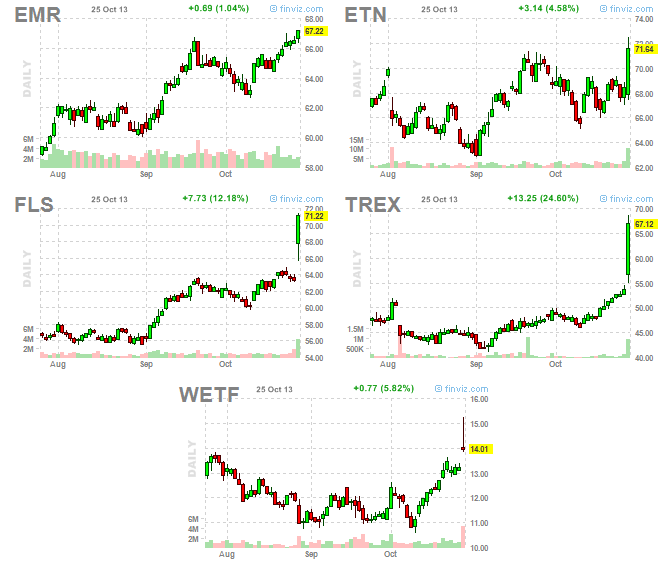
Here are the 5 new all-time high breakouts that made me the biggest impression from technical perspective:

Screen Shot 2013-10-27 at 8.40.33 AM