The True Nature Of Predicting

Jon Boorman has an interesting piece on the futility of making market predictions.

Long time ago, Phil Pearlman wrote an insightful post, pointing out the upside of making an outrageous prediction.

Here’s how it works.

If I make an outrageous prediction or label a prediction outrageous and I am wrong, I respond to criticism like this:

“Well, I said it was an outrageous prediction.”

This discounts my responsibility for being wrong to some degree. But if I am right, I will say,

“look how brilliant I am. I made an outrageous prediction and it was dead on.”

Outrageous predictions are used to manage impressions. One defers responsibility if wrong and gloats incessantly if right.

It is a manipulative gambit.

People, who make outrageous predictions know exactly what they are doing. Their potential reward is much bigger than the risk they are taking of being publicly laughed at. Many people have made a career by being right once about a major event that nobody expected (usually a big market correction).

Predicting and speculating have a lot in common, but they are also very different. By definition, predictions are about dealing with factors, you have no control over. When you speculate in the stock market, you also don’t have control over which one of your trades will be profitable and for the most part how profitable it will be. You could improve the odds, but you can’t impact the outcome of each individual trade. When you speculate, you put your own money at risk. You could be right for the wrong reasons and make money (lucky). You could also be wrong despite having an edge and still lose money (no approach has 100% success rate). Since you have very little control on some of the variables that impact your results, it doesn’t really make sense to speculate about only one outcome, because in this case you are getting prepared for only one outcome. The solution – You develop several different scenarios and you prepare for each of them.

A) You could be wrong

  • where is your stop loss?
  • How much of your capital are you going to risk?

B) You could be right

  • Where are you going to exit so you maximize not only your individual return on one particular trading idea, but your overall capital return, which takes into account opportunity cost.
  • Are you going to sell on strength, on weakness (when the trend for your time frame is invalidated).
  • Do you have a time stop in place – it assures that you don’t keep you capital in a non-performing assets.
  • Do you have a plan where to add to you position? One of my favorite market insights from George Soros says that “it doesn’t matter if you are right or wrong, but how much money you make when you are right and how much money you lose when you are wrong”.
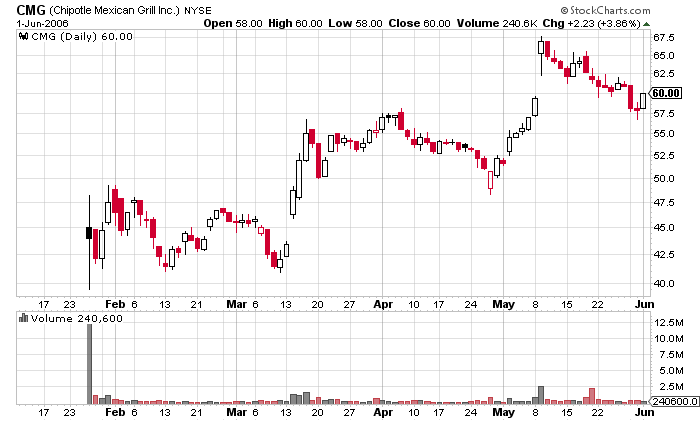
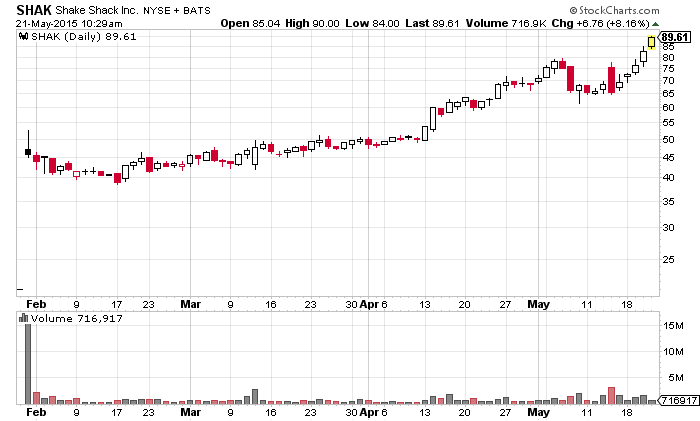
Is Shake Shack The New Chipotle?

Everyone has been looking for the next Chipotle. From a strictly price action perspective, $SHAK’s trend has been a lot more smoother and powerful than CMG in the first few months after its IPO. I have no idea how they compare from a valuation and store growth perspective. I don’t own any of them at this point of time. Take a look:

cmg-iposc

What Is The Role Of Luck In Success?

I am currently listening to “The Virgin Way” audiobook by Richard Branson. One of the more interesting stories so far covers the subjects of good luck and good judgement.

And then there are those other serendipitous situations that come along once in a life time, where being in the right place at the right time can present an opportunity that doesn’t require a preparation to take an advantage of it. When that happens, it falls to the individual’s ability to recognize a situation for what it is and seize the moment.

My friend, let’s call him Antonio, was raised in Santiago, Chile and eventually attended California’s prestigious Stanford University, where he would earn a post-graduate degree in business administration and behavioral sciences. One day, while he was attending Stanford, Antonio was waiting on a long line outside of a movie theater, when he and the stranger next to him were told that the show was sold out and they’ll have to come back another day. The two of them struck a conversation and with some unanticipated free time on their hands, ended up going for a cup of coffee together. Over coffee, Antonio asked what the stranger, who was also attending Stanford, was up to. Antonio was told that he and a fellow student were working on a research project that has something to do with search engines. As they parted company, the stranger handed a copy of his research paper and suggested he read it over so they could talk more the next day. Antonio said he tried reading the highly technical document at night, but the bulk of it was all about algorithms and way over his head. He was however highly intrigued with the object of the exercise, which was to organize a vast amount of information on the web according to the popularity of the pages. In short, it struck his as an idea that had a lot of market potential. When Antonio met up with his new friend the next day, he asked how he could get involved. He was told they were in the early stages of raising capital to launch their business, that it was valued at a million dollars and they’d love to have him as an investor. In what was to become the watershed moment in his life, Antonio responded by saying – “Well, I have $10,000 that was intended for a second-hand car, but I might consider putting it into your company instead. What could that get me?” He was told it would give him a 1% ownership stake. And so they agreed that they had a deal. If you haven’t guessed by now, the student Antonio was speaking to was Sergey Brin…

A counter-point to my friend Antonio’s story is that of Ronald Wayne. Wayne had worked alongside Steve Jobs at Atari and became of the co-founders of Apple, along with Jobs and Wozniak. At 40-years of age, Wayne was almost twice older than his co-founders, so he agreed to essentially add as the venture’s adult supervisor, in return of which he was given a 10% stake in the company. Among other things, Wayne drew the partnership agreement between the three, drafted the company logo and wrote the Apple I manual. For a variety of reasons however, Wayne didn’t just feel comfortable that things are going to work out. He also didn’t particularly enjoyed working with Jobs. And so, after only a couple of months, Wayne called it quits and relinquished his stock in the company for a one-time payout of eight hundred dollars…Was it bad luck or bad judgement? Maybe a bit of both, but I’ll let you make up your own mind on this one.

My Chilean friend was no Ronald Wayne and has been astute enough never to sell a single Google share. He never got the used car, but that $10,000 is now worth billions. Suffice it to say that luckiest thing to ever happened to him is that Antonio went to see a popular movie in a small theater. Had there been just two more sits left, his life would have been very different. But in terms of making the luck work for him, he had to have the smarts to recognize an opportunity when it came along and greater, still the gut to risk his $10,000 (about all he had at the time) on a couple of young fellow students with a dream. This one I’d certainly put down to a combination of good luck and good judgement – two elements that the sum of which will always be greater than the whole.