Silver Linings and Discounting Identified Risks

Last week started with fireworks and ended in flames. High volatility after a prolonged uptrend is a sign of distribution. Ever since the major reversal on May 22nd, market indexes have been in a distribution mode – choppy, range-bound environment, characterized with a large number of fake breakouts and breakdowns and where most trends last 2-3 days before there is price reaction.

An hour before the FED’s briefing on Wednesday, everything looked rosy and the S & P 500 was within a striking distance from testing its all-time highs. The St50 list was up 3.5%, four of its stocks were up more than 10% in a couple days, another ten stocks were up 4%+. Then Bernanke came and said that the economy is improving and tapering of the FED’s open market operations is within sight. The market reacted like child, whose birthday party has been canceled and staged a massive selloff. The St50 list finished the week down 1.55% and while it outperformed the $SPY and $QQQ, the technical damage to many of the leading stocks was notable and it will take some time to be repaired.

Financial markets have been discounting FED’s withdrawal since the end of May. Look at the massive rally in the yields and the epic selloff in the most interest rates sensitive assets. The 10-year yield has gone from 1.6% to 2.5% in six weeks. The REITs ETF ($IYR) is now down for the year after being up 20% by mid May. Emerging markets ($EEM) and long-term Treasuries ($TLT) hit new 52-week lows.
tlt

The silver lining of last week is that at least now we have some certainty in regards to FED’s plans and targets. Identified risks tend to be over-discounted by the market. While we might get a few more weeks of elevated volatility and forced liquidations, a good earnings season could get us back in everyone’s favorite “market of stocks” environment. Next earnings season starts in mid July.

The big question for the next few weeks is if the accelerated distribution and elevated volatility will turn into forced liquidation and clear downtrend. After a few big down days, the mood is always gloomy and it is easy to be pessimistic. The market in June has proven to surprise and mean-revert just when most have positioned themselves in one direction, so I think we will see more of the same.

New leaders always emerge out of market corrections and they are likely to appear on the St50 list before the meat of their moves. It is always worth it to pay attention to relative strength in weak markets.

Regional banks ($KRE) held their ground better than most last week. We even saw a few breakouts to new all-time highs ($SBNY). The steeping of the yield curve is positive for the group.

Last week, we talked about the major re-pricing in media stocks. Many of them showed incredible resilience during the pullback and are hovering near multi-year highs: $SBGI $NXST among others. It is a group that deserves special attention.

Also, contrary to the popular perception that defense stocks should take a massive hit from the sequestration, many of them have managed to have a very decent 2013 and are holding near all-time highs: $IRBT $TDG $GY.

There is a strong underlying bid for small and mid cap software and cloud stocks too: $WAGE $TYPE $ULTI $CSOD $EPAM $VNTV…

It Is A Very Choppy Environment, But Opportunities Abound For Nimble Traders

The S & P 500 lost 1%, Nasdaq 100 lost 1.5%, small caps shed 0.5% and yet overall there were more stocks that went up 10% for the week (54) than went down 10% for the week (42). It continues to be a market of stocks environment with good opportunities for both bulls and bears, who know how to manage risk. The ST50 list finished the week flat (gained 3 basis points) outperforming the indexes by a good margin.

$SPY tested its rising 50dma for a second time in two weeks. Technicians say that the more one level is tested, the weaker it becomes and the more likely to be taken out. A break below the 50dma is not the end of the world. Many trends test their longer-term moving averages before they resume higher – 100dma, 200dma and even the 50-week MA.

spx

It is a very choppy environment, but opportunities abound for nimble traders who have managed to adjust to the range-bound market environment. Most of the trends last up to 2-3 days before there is a major price reaction. We need to start every day with an open mind and be prepared to see everything.

Three industries stood above the rest last week:
– restaurants: tepid inflation coupled with rising consumer confidence and pure price momentum send stocks $CHUY, $SONC and $RUTH at new multi-year highs. There are a lot more names in the group that are hovering near 52-week highs: $CMG, $TXRH, etc.
– media: the ongoing consolidation in the field is re-pricing the whole TV broadcasting industry. Many of the stocks in the group gained more than 5% last week: $SBGI, $NXST, $SSP, $TVL, etc.
– mortgage investment companies were among the best performers in 2012 and it looks like are returning back to fashion: $OCN, $HLSS, $NSM, $ASPS, etc.

Patterns repeat all the time in financial markets. The only things that change are the names of the symbols involved. Corrections through price and time are a normal stage of any liquidity cycle and they should be embraced as playing a crucial role in the discovery of future leaders. The silver lining of all market corrections is that they highlight the strong stocks with organic demand or real alpha. Pay attention to stocks that make new 52-week highs or gain more than 3% on big down days. For example, during the selloff on Wednesday, one of the very few stocks that made new all-time highs was $CSOD. Then, it proceeded to spike more than 5% near the end of the week.

Most stocks dipped on Friday, when the $SPY struggled just below its already declining 20-day moving average. Here are six St50 members that showed relative strength:
RS June 14

In the book Hedge Fund Market Wizards, one of the featured traders (Jamie Mai) talks about two types of risk – identified and unidentified:

Markets tend to over-discount the uncertainty related to identified risks. Conversely, markets tend to under-discount risks that have not yet been expressly identified. Whenever the market is pointing at something and saying this is a risk to be concerned about, in my experience, most of the time, the risk ends up being not as bad as the market anticipated.

There are two major macro factors that seem to account for the majority of the recent market volatility:
– the re-winding of the Japanese Yen carry trade
– the discounting of potential tapering in the FED’s open market operations

The big question is how much of those risks have already been discounted by the market? They have already been covered extensively by the press, which by no means guarantees their impact will be reduced.

What I wrote about the market on June 6th continues to play out:

There is still plenty of risk appetite for buying dips in select U.S. equities. Today’s bounce does not change the big picture. We are still in a range-bound market environment with elevated volatility – an environment that is known to produce a lot of fake breakouts and breakdowns and be more favorable to mean-reversion setups from important technical levels. This does not mean that the market won’t look strong or weak for 2-3 days in a row. It will look strong or weak long enough to convince most market participants to lay in one direction and then it will swiftly pull the rug under their feet.

With that in mind, there are still plenty of opportunities for nimble traders that manage to quickly adjust to the new market environment and realize that many breakouts and breakdowns are likely to deliver a lot smaller gains than what we got used to in the first 5 months of the year.

Amazon Continues To Take Over The Retail World One Step At A Time

Most companies think about what will change in the next 10 years and position their business according to their projections and expectations. The truth is that no one knows what the next 10 years will look like and what novelties they are going to bring. The globe is moving faster than ever. Product cycles are a lot shorter. So is our attention span. Innovation is travelling faster than the speed of sound. We change our minds and preferences more often. Billion dollar companies are made and ruined within the scope of a decade. It seems that change is the only constant, but is it?

Amazon’s founder and CEO, Jeff Bezos does not believe so. He thinks about what will not change 10 years from now and builds Amazon’s long-term strategy around those constants. Lower prices, great service, faster deliveries and greater product selection – these are cornerstones that are not going to change no matter what. People are not likely to ask to pay more, receive their deliveries slower, have less to choose from and get crappy customer service.

If you stop to innovate, you better close doors and give the money back to your shareholders. This is what corporate America has been doing lately. Not the part about closing doors, but the part about giving back shareholders money through hefty dividends and buybacks. Wal-Mart is the latest example. They announced a new $15 Billion buyback on Friday. Borrowing for share repurchases is the new game in town and almost everyone is playing. Not, Amazon. Yes, they also took advantage of the record low interest rate environment to borrow, but one cannot blame them for lack of ideas where to put their money to work. Amazon continues to innovate and invest in its platform as if it was day one of its journey.

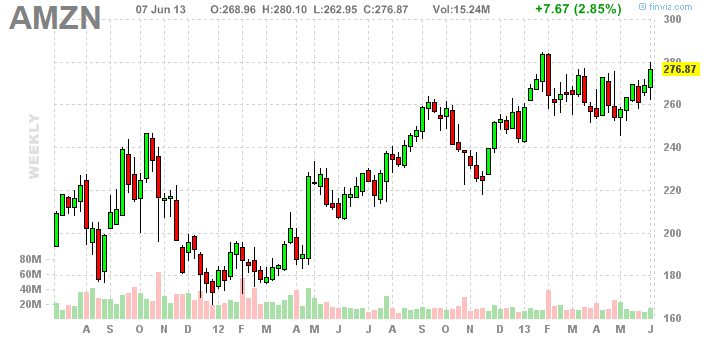
Over the past week alone, Amazon opened its first online store in India, announced that it will sell Kindles in China and expand its nationwide same-day grocery delivery service in the U.S. The market seems to be liking Amazon’s geographic and product expansion. Shares of the online retail giant gained 3% in a volatile week and are trading within very close proximity of their all-time highs of $284.72.

Screen Shot 2013-06-08 at 7.47.52 AM

This is not even the big picture of why you might want to consider Amazon as a long-term holding. In 2001, e-commerce accounted for less than 1% of the total retail revenue in the U.S. Today, this number is still only 6.5% in the U.S, which accounts for 5% of the world population. The percentage of online sales is much smaller in the rest of the globe and it is bound to quickly grow in the next decade. If I had to choose one company that is likely to benefit the most from this huge e-commerce trend, it would be Amazon.

Screen Shot 2013-06-08 at 7.49.33 AM