Five Market Insights from George Soros

George Soros is a living legend among traders. With a net worth of $28 Billion, he is the richest market speculator in the world, after Buffett. What’s interesting is that he started his hedge fund when he was 42 years old. His proteges share that his batting average is terrible. They say he has been right about 30% of the time, but when he is right, he’s right and he makes sure to fully capitalize on it. His trading philosophy could be best described with two phrases:

“It doesn’t matter if you are right or wrong, but how much money you make when you are right, and how much money you lose when you are wrong”

“When you have a tremendous conviction on a trade, you have to go for the jugular. When you are right on something, you can’t own enough”.

Here are a few more tidbits that reveal how Soros thinks about financial markets:

Perceptions affect prices and prices affect perceptions

I believe that market prices are always wrong in the sense that they present a biased view of the future. But distortion works in both directions: not only do market participants operate with a bias, but their bias can also influence the course of events.

For instance, the stock market is generally believed to anticipate recessions, it would be more correct to say that it can help to precipitate them. Thus I replace the assertion that markets are always right with two others: I) Markets are always biased in one direction or another; II) Markets can influence the events that they anticipate.

As long as the bias is self-reinforcing, expectations rise even faster than stock prices.

Nowhere is the role of expectations more clearly visible than in financial markets. Buy and sell decisions are based on expectations about future prices, and future prices, in turn are contingent on present buy and sell decisions.

On Reflexivity

Fundamental analysis seeks to establish how underlying values are reflected in stock prices, whereas the theory of reflexivity shows how stock prices can influence underlying values. One provides a static picture, the other a dynamic one.

Financial markets do not play a purely passive role; they can also affect the so-called fundamentals they are supposed to reflect. These two functions, that financial markets perform, work in opposite directions. In the passive or cognitive function, the fundamentals are supposed to determine market prices. In the active or manipulative function market, prices find ways of influencing the fundamentals. When both functions operate at the same time, they interfere with each other. The supposedly independent variable of one function is the dependent variable of the other, so that neither function has a truly independent variable. As a result, neither market prices nor the underlying reality is fully determined. Both suffer from an element of uncertainty that cannot be quantified.

On bubbles

When I see a bubble forming, I rush in to buy, adding fuel to the fire. That is not irrational.

Boom-bust processes are asymmetric in shape: a long, gradually accelerating boom is followed by a short and sharp bust. The bust is short and steep because it involves the forced liquidation of unsound positions.

First, financial markets, far from accurately reflecting all the available knowledge, always provide a distorted view of reality. The degree of distortion may vary from time to time. Sometimes it’s quite insignificant, at other times, it is quite pronounced. When there is a significant divergence between market prices and the underlying reality, there is a lack of equilibrium conditions.

I have developed a rudimentary theory of bubbles along these lines. Every bubble has two components: an underlying trend that prevails in reality and a misconception relating to that trend. When a positive feedback develops between the trend and the misconception, a boom-bust process is set in motion. The process is liable to be tested by negative feedback along the way, and if it is strong enough to survive these tests, both the trend and the misconception will be reinforced. Eventually, market expectations become so far removed from reality that people are forced to recognize that a misconception is involved. A twilight period ensues during which doubts grow and more and more people lose faith, but the prevailing trend is sustained by inertia.As Chuck Prince, former head of Citigroup, said, ‘As long as the music is playing, you’ve got to get up and dance. We are still dancing.’ Eventually, a tipping point is reached when the trend is reversed; it then becomes self-reinforcing in the opposite direction.

On trend following

Once a trend is established it tends to persist and to run its full course.

Currency movements tend to overshoot because of trend-following speculation, and we can observe similar trend-following behaviour in stock, commodity and real estate markets, of which Dutch Tulip Mania was the prototype.

When a long-term trend loses its momentum, short-term volatility tends to rise. It is easy to see why that should be so: the trend-following crowd is disoriented.

Markets might be forward-looking, but they are not always right

How good are markets at predicting real-world developments? Reading the record, it is striking how many calamities that I anticipated did not in fact materialise.

Financial markets constantly anticipate events, both on the positive and on the negative side, which fail to materialise exactly because they have been anticipated.

It is an old joke that the stock market has predicted seven of the last two recessions. Markets are often wrong.

It doesn’t hurt you what you don’t know, but what you think you know, when it ain’t so

Participants act not on the basis of their best interests but on their perception of their best interests, and the two are not identical.


On Manipulation

I want to buy $300 million of bonds, so start by selling $50 million. I want to see what the market feels like first.

On how to be selectively active

The trouble with you, Byron [Byron Wein – Morgan Stanley], is that you go to work every day [and think] you should do something. I don’t, I only go to work on the days that make sense to go to work. And I really do something on that day. But you go to work and you do something every day and you don’t realise when it’s a special day.
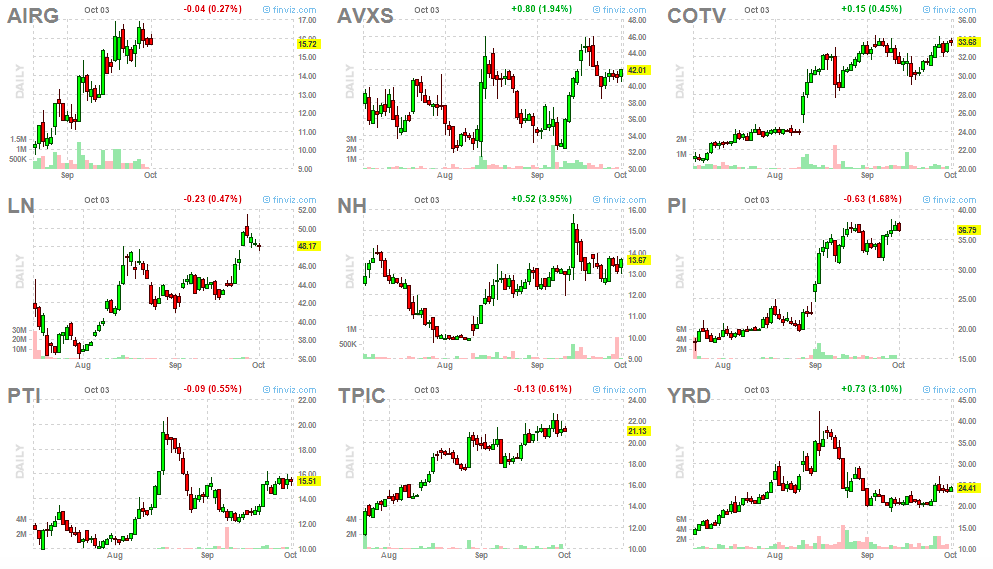
A Few Recent IPOs that I am Watching

The IPO market is gradually coming back. After the huge run-ups in ACIA and TWLO, more companies are eager to go public. We may not be too far from seeing a really big fish filing for an IPO – Snapchat or Uber.

Based on current price action, the market is eager for new IPOs. Taking into account that all new companies offer only 10 to 20% of their float and thousands of funds compete to own a limited number of shares, it is not a big surprise that IPOs are a favorite trading vehicle for many traders.

Here are a few names that I am watching: NTNX, COTV, NH, PI, TPIC, LN, PTI, YRD, AVXS, AIRG, FLGT, etc.

a

Five Market Insights from Paul Tudor Jones

Paul Tudor Jones is one of the most emblematic figures in the hedge fund industry. His best percentage returns happened during severe market corrections: 126% after fees in 1987 when U.S. markets lost a quarter of their market cap in one day. 87% in 1990 when the Japanese stock market plunged. 48% during the tech crash of 2000-2001. He returned 5% in 2008. His funds have underperformed in the past 8 years. He charges 2.75% management fee and 27% performance fee, which significantly above the industry average of 2 and 20.

Outside of financial markets. PTJ founded the Robin Hood foundation, which attempts to alleviate problems caused by poverty in NYC.

The biggest conundrum when studying successful money managers is do you pay attention to what they are doing today or do you focus on what they were doing before they became widely popular, were managing a lot less money and had a lot higher returns?

Here PTJ talks about how new powerful trends often start – basically, a big price expansion from a long base.

The basic premise of the system is that markets move sharply when they move. If there is a sudden range expansion in a market that has been trading narrowly, human nature is to try to fade that price move. When you get a range expansion, the market is sending you a very loud, clear signal that the market is getting ready to move in the direction of that expansion.

PTJ on risk management

If I have positions going against me, I get right out; if they are going for me, I keep them… Risk control is the most important thing in trading. If you have a losing position that is making you uncomfortable, the solution is very simple: Get out, because you can always get back in.

I am not sure he can do that today with the size he is trading. The approach that made him an investing legend might not be the approach that he is using today. He is trading a lot more money and size can change everything, especially when you trade other people’s money.

PTJ is famous for the saying “losers average down losers” and yet if you look at his hedge fund’s record, he dollar-cost averages all the time. Again, the size of his fund has forced him to change his market approach. You can’t just get in and out from a billion dollar position whenever you decide to. There’s not enough liquidity and if you don’t invest enough in your best setups, you are guaranteed to underperform after management fees. It is normal to ladder in and out when you trade with size.

When you are trading size, you have to get out when the market lets you out, not when you want to get out.

That cotton trade was almost the deal breaker for me. It was at that point that I said, ‘Mr. Stupid, why risk everything on one trade? Why not make your life a pursuit of happiness rather than pain?’

Another popular speculator, Jim Rogers is often quoted saying that “he has never met a rich technician”. Well, here’s PTJ on the value of technical analysis:

Markets have consistently experienced “100-year events” every five years. While I spend a significant amount of my time on analytics and collecting fundamental information, at the end of the day, I am a slave to the tape and proud of it.

I see the younger generation hampered by the need to understand and rationalize why something should go up or down. Usually, by the time that becomes self-evident, the move is already over.

When I got into the business, there was so little information on fundamentals, and what little information one could get was largely imperfect. We learned just to go with the chart. Why work when Mr. Market can do it for you? These days, there are many more deep intellectuals in the business, and that, coupled with the explosion of information on the Internet, creates an illusion that there is an explanation for everything and that the primary task is simply to find that explanation. As a result, technical analysis is at the bottom of the study list for many of the younger generation, particularly since the skill often requires them to close their eyes and trust price action. The pain of gain is just too overwhelming to bear.

***

I teach an undergrad class at the University of Virginia, and I tell my students, “I’m going to save you from going to business school.  Here, you’re getting a $100k class, and I’m going to give it to you in two thoughts, okay?  You don’t need to go to business school; you’ve only got to remember two things.  The first is, you always want to be with whatever the predomianat trend is.

My metric for everything I look at is the 200-day moving average of closing prices.  I’ve seen too many things go to zero, stocks and commodities.  The whole trick in investing is: “How do I keep from losing everything?”  If you use the 200-day moving average rule, then you get out.  You play defense, and you get out.

Trading manias and crashes cannot be taught. It can only be experienced:

There is no training — classroom or otherwise — that can prepare for trading the last third of a move, whether it’s the end of a bull market or the end of a bear market. There’s typically no logic to it; irrationality reigns supreme, and no class can teach what to do during that brief, volatile reign. The only way to learn how to trade during that last, exquisite third of a move is to do it, or, more precisely, live it. Fundamentals might be good for the first third or first 50 or 60 percent of a move, but the last third of a great bull market is typically a blow-off, whereas the mania runs wild and prices go parabolic.

He looks for great risk/reward setups. Sometimes, those setups are near market’s major turning points:

I look for opportunities with tremendously skewed reward-risk opportunities. Don’t ever let them get into your pocket – that means there’s no reason to leverage substantially. There’s no reason to take substantial amounts of financial risk ever, because you should always be able to find something where you can skew the reward risk relationship so greatly in your favor that you can take a variety of small investments with great reward-risk opportunities that should give you minimum draw down pain and maximum upside opportunities.

I believe the very best money is made at the market turns. Everyone says you get killed trying to pick tops and bottoms and you make all your money by playing the trend in the middle. Well for twelve years I have been missing the meat in the middle but I have made a lot of money at tops and bottoms.