Buying the Blood on the Street Is Easy Only in Hindsight

In his latest post, Frank Zorrilla makes an astute observation that the four best-performing ETFs year-to-date were all down several years in a row heading into 2016.

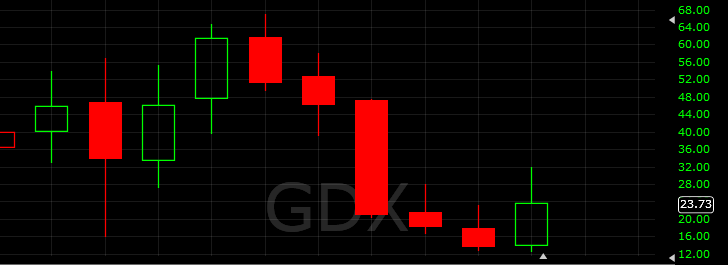
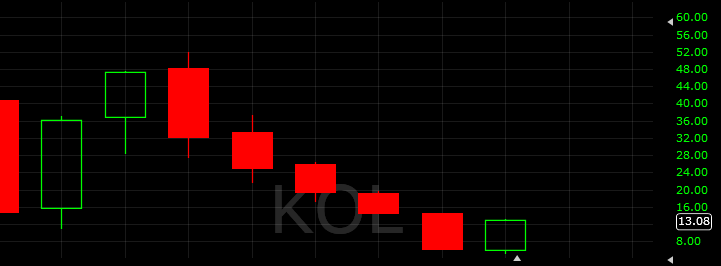
The best performing single ETF’S this year have been KOL (+108%), GDXJ (+107%), EWZ (+83%), and GDX (+72%).

Recent data by Dimson, Marsh, Staunton database, showed median country returns of 8.74% (all years) and 15.94% after three down years in a row, both suggest that you will double the median return of all years if you own a country ETF that is down three years in a row.  It’s a very rare occasion that only happens 3% of the time.

If you take a closer look at this year’s top ETF gainers, you will notice that they were not down three years in a row. They were down 4 or 5 years in a row in the midst of a powerful bull market. Anyone who thought they were a great bargain in early 2014 or early 2015, bought too early and saw another 40% to 60% decline before there was finally a more sustainable relief rally. It doesn’t matter if you just manage your own money or other people’s money. You cannot lose 50% on a position in a bull market and remain in business.

The best performing industries in any given year are usually the ones that surprise the most. What are the type of industries no one expects to substantially outperform? The ones that were down a lot several years in a row and the ones that were up the most several years in a row. In the first case, no one really cares about those industries. They are not simply hated, they are ignored. In the second case, no one believes that their upside run can continue any longer.

There is not one sure recipe for finding the best performing industries every single year. Sometimes, they come from the bottom of the pit. Other times, they come from the top. We have to be flexible and willing to continually adjust to ever-changing market cycles.

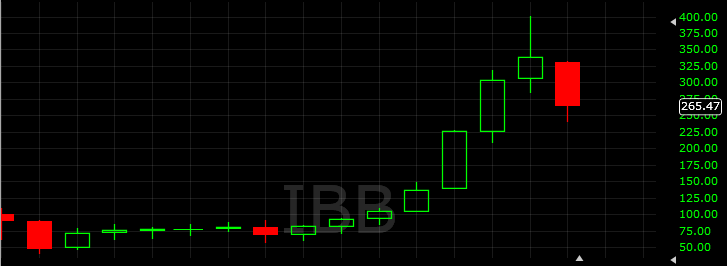
Take a look at the long-term charts of the above-mentioned sectors. Each candle represents one year of price action.
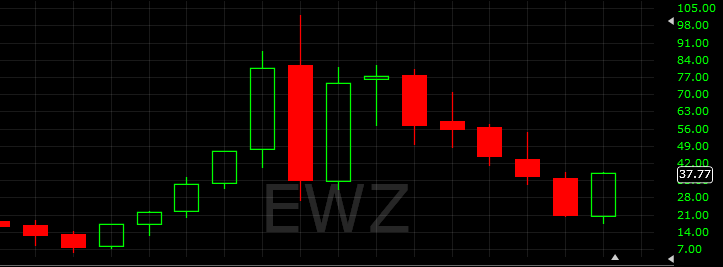
ewz

kol

gdx

ibb

Financial Markets Are Full of Surprises – for Some More than Others

Morgan Housel is out with an interesting post, basically claiming that if you study past history you will learn a lot about history, but very little about the future. The lessons from the past financial crisis are not going to help us with the next financial crises. Life is full of surprises. There is very little we can do to be fully prepared for them. As an ancient proverb goes “when men make plans, gods are laughing”.

He makes some good points. The events and processes that caused the last market correction or bubble are probably never going to repeat in their literal form. Does this mean that studying financial history is futile?

You can learn more relevant lessons that are more likely to pass the test of time if you dig deeper; if you go straight to the source of market corrections and booms – human psychology. When it comes to fear and greed, nothing ever changes. What caused fear of losing and fear of missing out 100 years ago causes the same emotions and reactions today and it’ll cause the same attitude 100 years from now.

The reasons for market corrections might change, the names of the winning and losing stocks might change, but human emotions and psychology are likely to remain the same. One of the best and the most unbiased reflection of human emotions is price action. Technical analysis continues to be an underappreciated tool for risk management, market timing, and equity selection.

What we know with almost 100% confidence is that there will be other big market corrections and bubbles in the future. They will probably be caused by events and processes no one can predict. Most people will react similarly to wild price gyrations. Some will view market crashes and booms as irrational exuberance, others will be prepared better and see in them incredible opportunities.

Five Market Insights from Peter Lynch

Peter Lynch managed the Magellan mutual fund at Fidelity Investments between 1977 and 1990. He averaged a 29% annual return and managed to increase his fund’s assets under management from $18 million to $14 billion. Magellan started as a private investment arm for Fidelity’ founding Johnson family. The fund didn’t open to outside investors until 1981. Between 1981 and 1990, Lynch managed to return 22.5% per year vs 16.5% for the S&P 500. During that period, the average investor at Lynch’s fund made 7% a year. Why the big discrepancy? Well, many investors sold Magellan fund when it had a down year and bought it back when it had a good year.

The majority of Peter Lynch’s returns came when he was managing a relatively small amount of capital. He was also lucky to start at Magellan at the end of one of the biggest and longest bear markets in financial history, which brought many stocks to extremely low valuations.

Peter Lynch is also one of the most prolific writers, whose market thoughts continue to be widely quoted and applied to these days. Here are some of my favorite:

The two biggest mistakes that investors make

There are two ways investors can fake themselves out of the big returns that come from great growth companies.  The first is waiting to buy the stock when it looks cheap.  Throughout its 27-year rise from a split-adjusted 1.6 cents to $23, Walmart never looked cheap compared with the overall market.  Its price-to-earnings ratio rarely dropped below 20, but Walmart’s earnings were growing at 25 to 30 percent a year.  A key point to remember is that a p/e of 20 is not too much to pay for a company that’s growing at 25 percent.  Any business that an manage to keep up a 20 to 25 percent growth rate for 20 years will reward shareholders with a massive return even if the stock market overall is lower after 20 years.

The second mistake is underestimating how long a great growth company can keep up the pace.

Let Your Winners Run

It’s easy to make a mistake and do the opposite, pulling out the flowers and watering the weeds.  If you’re lucky enough to have one golden egg in your portfolio, it may not matter if you have a couple of rotten ones in there with it.  Let’s say you have a portfolio of six stocks.  Two of them are average, two of them are below average, and one is a real loser.  But you also have one stellar performer.  Your Coca-Cola, your Gillette.  A stock that reminds you why you invested in the first place.  In other words, you don’t have to be right all the time to do well in stocks.  If you find one great growth company and own it long enough to let the profits run, the gains should more than offset mediocre results from other stocks in your portfolio.

Look for situations, where perceptions are worse than reality

The big winners come from the so-called high-risk categories, but the risks have more to do with the investors than with the categories.

Embrace market corrections

It is not entirely clear what causes deep market corrections (a clear prove that markets are irrational), but without them many of the best performing long-term investors would have never achieved their spectacular returns.

The biggest winners are usually a pleasant surprise

The point is, there’s no arbitrary limit to how high a stock can go, and if the story is still good, the earnings continue to improve, and the fundamentals haven’t changed, “can’t go much higher” is a terrible reason to snub a stock. Shame on all those experts who advise clients to sell automatically after they double their money. You’ll never get a ten-bagger doing that.

Frankly, I’ve never been able to predict which stocks will go up tenfold, or which will go up fivefold. I try to stick with them as long as the story’s intact, hoping to be pleasantly surprised. The success of a company isn’t the surprise, but what the shares bring often is.