How Could Apple Become A Trillion Dollar Company

Most agree that in order for $AAPL to recover some of its glimmer back, it needs to enter and dominate new categories. Yes, the smart phone and the tablet industry has a lot of room to grow. The pie is growing fast enough for Apple to continue to grow even if it losing market share to Android-powered devices. And yes, Apple will probably be an important player in wearable computing. The rumored iWatch will probably be lightning years ahead of Samsung’s first Smartwatch, at least for awhile. The truth is that the iWatch might be too small to make a difference – something like XBOX for Microsoft.

A lot has been said about Apple’s new dividend and buy-back policy. Some say that there is nothing wrong if a company gives money it doesn’t need for growth back to its shareholders. Maybe they are right, maybe they aren’t. In my eyes, it is a testament that Tim Cook and co don’t have enough imagination and vision to run this great company. It is a sign that no one at Apple is thinking different and bold enough. This could be changed.

Apple already has the mind share and the distribution solved. Now, all it needs is new product categories to offer in its stores.

Apple does not need to invent all its products in order to dominate.  It could do as all big and popular fashion brands do: acquire new products or license its name to other cool products. Jony Ive is not the only brilliant designer in the world. There are plenty like him that are doing amazing job.

For example, Michael Kors licenses its trademark to fragrances, cosmetics, eyewear, leather goods, jewelry, watches, coats, footwear, men’s suits, swimwear, furs and ties. Apple should do something similar and be extremely selective in choosing its partners. Jawbone, iRobot, Nike and Tesla are a good place to start.

People that own an iPhone, iPad, iMac would love to own other cool products with the brand Apple – washing machines, headsets, speakers, smart clothes…

Apple should not be viewed only as a technology brand. It is a life style brand.

I don’t have any positions in $AAPL at the time of writing this post.

Are All Secondary Offerings Negative Events?

Pandora Media ($P) announced a secondary offering and it still went up to new all-time closing highs above $25. Its float will increase by 14 million shares, four million of which are sold by insiders.

LinkedIn ($LNKD) raised a billion dollars in a secondary earlier this month. It still made new all-time highs.

Zillow announced a secondary on August 19: 2.5M shares at $82. $Z is trading near $100 today.

In February 2013, Michael Kors priced a humongous secondary offering: 25 million shares at $61. $KORS is trading near $75 today.

Sure, there are plenty of examples of stocks being killed after announcing secondary offerings. The bull market in 2013 has been very forgiving and capable of absorbing secondaries.

On the surface, most secondaries are viewed as negative events for three main reasons:

1) A secondary represents an increase in company’s float, which dilutes current shareholders and potentially could lead to an increase in supply down the road. This is not always the case (the increase in supply) and i will explain why in a bit.
2) It is always priced below the current market price to entice institutions into buying big blocks of shares.
3) Insiders selling is always looked with suspicion.

Secondary offerings are an organized transfer of ownership, often from weak to strong hands. Counter-intuitively, they could be positive if there are enough institutions willing to participate.

Depending on who is selling, secondary offerings help:

1) companies to raise more cash for operating and expanding purposes. The companies are in stronger financial position after the offering. You raise when you can, not when you have to.
2) insiders sell in an organized manner. there is a transfer of ownership from insiders, who would sell on the open market anyway, to institutions, who are more likely to be long-term holders.
3) institutions to accumulate large blocks of stocks they want to own at prices slightly below market. If they had to buy the same number of shares at the open market, it would probably cost them a lot more. Institutional interest is generally considered a positive sign. If a stock runs from 20 to 40 and has a secondary at 35, the event could be considered a stamp of approval; a justification of the current prices in a way.

Remember, the market is designed to fool most of the people most of the time and it is often counter-intuitive.

In no way I am saying that secondaries are always positive events. I am just open-minded to the thesis that sometimes they could be. I am a big believer in the philosophy that “Reaction to news is more important than the news itself”. When I see a stock, making new all-time high after announcing a secondary, I consider that a really good sign.

Positive reaction to what appears to be “bad” news on the surface is bullish. When stocks don’t fall on bad news, good news is usually just around the corner.

At the moment of writing, I don’t own any of the mentioned stocks in this post. I am just sharing my thought process.

st50_ad_leaderboard_20130626

Twitter Files For An IPO. Should You Care?

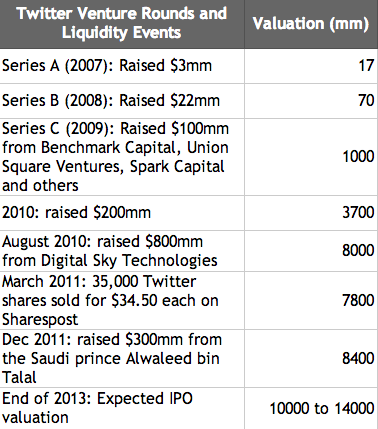
Twitter ValuationIt has been a good month for the Social Web. Facebook ($FB) finally cleared new all-time highs and now even the gamblers who blindly sent buy-at-market orders on the day of its IPO are above the watermark. LinkedIn ($LNKD) raised a billion dollars in a secondary offering and its stock did not even blink. In fact, it is still trading near all-time highs. Twitter filed for an IPO, which probably explains the buzz around all other social web stocks.

We live in a fast world. Twitter has made it even faster. It started as a side company project and in a few short years, it became the most powerful media company in the world. Founded in 2006, raised its first money in the summer of 2007 – 3 million on a valuation of 17 million. In 2009, Twitter’s CEO Dick Costolo said that VCs value Twitter at 1 billion and he was laughed at. Who is laughing now? Initial projections are for a $14 Billion IPO. It is expected to reach revenues of more than half a billion dollars for 2013, but it is not profitable yet. In a counter-intuitive way, this is good news. Yelp was not profitable either when it IPO-ed. It means that it is relatively early in its growth cycle – not in terms of users acquisition, but in terms of monetizing those users.

Why is Twitter Going Public Now? At the top of my head, there are four distinct reasons:

1) The market is ready. You don’t go public when you have to, but when you can. Investment bankers are confident in the current ability of the market to absorb supply from big IPOs, especially in the social web field, which has never been so hot.
2) Twitter cannot get much higher valuation in the private market
3) VCs are pushing for an exit. The moment you take venture money, you have to start planning for an exit and for billion dollar companies, an Initial Public Offering is basically the only viable exit strategy.
4) Twitter needs money to compete for strategic acquisitions. Last year, they wanted to buy Instagram and were ready to pay 700M, but Facebook outbid them with $1 Billion.

Now, they will have the road trips, where Twitter management will try to convince a bunch of old men to invest your pension money into the new media shares. One thing is for sure, Dick Costolo won’t be wearing a hoody on those presentations. I don’t think he will have any troubles convincing the institutions.

How Will Twitter’s IPO affect you as an investor?

The rule of thumb is to stay away from any IPO that is widely publicized and massively expected. If your mom, who never cares about stocks, calls you and asks you if it is a good idea buy Twitter’s IPO, then you should definitely not buy.

The first six months to one year after an IPO are usually a period of ownership transfer – from insiders to mutual funds, hedge funds and retail investors. They are also a period of elevated volatility and trendless grinding. Historically, most big market winners, have started their ascent about a year after their IPOs. Yelp, Tesla and LinkedIn are good recent examples. There have been exclusions to the rule, but rare.