Size Matters

One of the more interesting speeches that I remember from Stocktoberfest 2014 was given by Jack Schwager – the author of the well-known Market Wizards Books. He told the story of Martin Schwartz and how he managed to achieve 25% monthly returns for a prolonged period of time. This is 25% per month, not per year. Schwartz’s trick? He would start with $400k and every time his account goes to 1mill, he would take some money out of the market and start over again with 400k. For his type of trading, he had to work with a smaller amount. I see the same behavior in many intra-day traders – they work with relatively small amount of capital and constantly take money out of the market. This behavior might seem counter-intuitive to many as it fails to take advantage of money compounding, but in fact it simply recognizes the limits of every trading approach. The truth is that capital size is like gravity – it matters, a lot.

Everyone desires to manage more money, but not everyone realizes that more capital could actually mean fewer trading opportunities. I wrote about this earlier this year and it remains relevant. There is a reason why a small 10-million dollar hedge fund could easily outperform a 10-billion dollar hedge fund. A small fund or a trader could afford to have 5% capital allocation and take hundreds of short-term trades in a year. A larger fund has a lot less great liquid opportunities in a given year. The only way for a 10-billion dollar fund to achieve good return is through concentration – putting 20% or more of capital into one great setup. The latter just follows a very simple rule – concentration creates wealth, diversification protects it.

Have you thought on the subject of capital size? At what point your capital size will negatively affect your performance?

Check my new book: The 5 Secrets To Highly Profitable Swing Trading
Easier Said Than Done, But Here’s Howard Marks on Forced Liquidation

Most investors—and certainly most nonprofessionals—know little about technicals. These are non-fundamental factors—that is, things unrelated to value—that affect the supply and demand for securities. Two examples: the forced selling that takes place when market crashes cause levered investors to receive margin calls and be sold out, and the inflows of cash to mutual funds that require portfolio managers to buy. In both cases, people are forced to enter into securities transactions without much regard for price.

Believe me, there’s nothing better than buying from someone who has to sell regardless of price during a crash. Many of the best buys we’ve ever made occurred for that reason. A couple of observations are in order, however:

• You can’t make a career out of buying from forced sellers and selling to forced buyers; they’re not around all the time, just on rare occasions at the extremes of crises and bubbles.

• Since buying from a forced seller is the best thing in our world, being a forced seller is the worst. That means it’s essential to arrange your affairs so you’ll be able to hold on—and not sell—at the worst of times.

This requires both long-term capital and strong psychological resources. And that brings me to the second factor that exerts such a powerful influence on price: psychology. It’s impossible to overstate how important this is.

Source: Marks, Howard (2011-04-19). The Most Important Thing: Uncommon Sense for the Thoughtful Investor (Columbia Business School Publishing) (pp. 26-27). Columbia University Press. Kindle Edition.

Sometimes, Stocks Go To Zero

chart-1

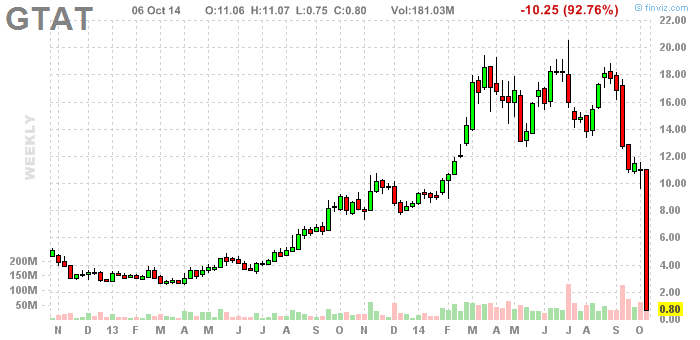
GT Advanced Technologies – the company behind one of the hottest stock market stories in the past year, the next big growth name that was supposed to make sapphire glass for future Apple products, filed for bankruptcy this week.

A strong bull market in solar stocks, coupled with a multi-million dollar contract from Apple, catapulted GTAT from $4 to $20 between July 2013 and July 2014. Apparently, Apple turned out to be too big of a bite for $GTAT and they could not deliver to their contractual obligations. The result – Chapter 11 of what used to be an almost 3-billion dollar company just two months ago.

Trends start and end all the time. If you don’t know why you are in a stock, you won’t know when it is the right time to exit. If price was the reason to buy a stock, price should be the reason to sell it.

There was absolutely no reason to own GTAT before its bankruptcy announcement. It was in a well-defined downtrend with price trading below all its major moving averages – 20-day, 50-day, 200-day. This is why following price matters. You could have the greatest growth story in the world, but until the market agrees with you, you cannot make a penny. Market’s way of agreeing with you is by sending your stocks to the 52-week high list or at least to new 50-day high from a proper technical base.

Financial markets constantly discount events that have not happened yet. As a result, they sometimes discount events that will never happen. A stock could quintuple in a year based solely on investors’ speculations and expectations for future profits. The stock market might be forward-looking, but it is not stupid or naïve. It constantly looks for feedback that will confirm its discounting of the future. When it gets tired of waiting or it doesn’t receive the expected feedback in terms of earnings and sales, it quickly reverses in the opposite direction.

Check my new book: The 5 Secrets To Highly Profitable Swing Trading